
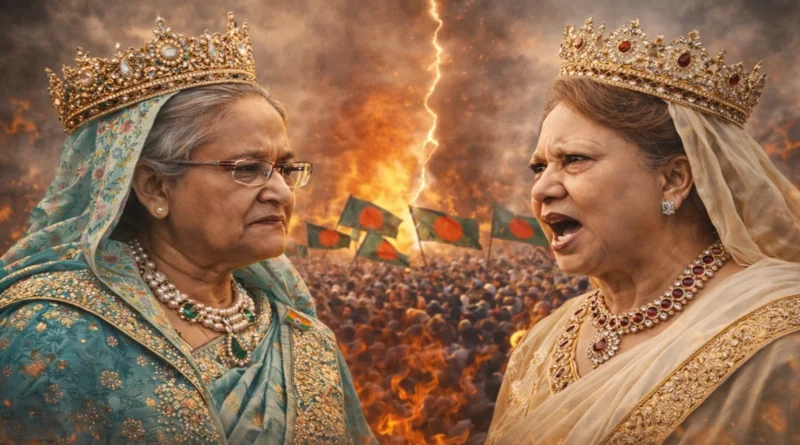
The ‘Battle of the Begums’: How Sheikh Hasina and Khaleda Zia Shaped—and Divided—Bangladesh’s Politics
There is a popular saying that two swords cannot coexist in one sheath. A closer look reveals that Bangladesh’s political history has revolved almost entirely around this idea. Since emerging as an independent nation after breaking away from Pakistan in 1971, Bangladesh has witnessed repeated rebellions, bloodshed, and coups. At the heart of this turbulent history stand two powerful women—Sheikh Hasina and Khaleda Zia—whose long-running rivalry came to be known as the “Battle of the Begums.”
For decades, Bangladesh’s politics revolved around these two towering figures. Sheikh Hasina is the daughter of Sheikh Mujibur Rahman—revered as Bangabandhu, the founding leader and first President of Bangladesh. Khaleda Zia, on the other hand, was the wife of former military officer and President Ziaur Rahman. Both came from influential families and carried forward their respective political legacies. Their struggle for power defined the nation’s political landscape, marked by periods of uneasy cooperation as well as intense hostility.
Today, with one of them no longer alive, the other has publicly acknowledged her rival’s contribution to the country’s political life.
Winner Takes All, Loser Pays the Price
Since 1971, Bangladesh’s political destiny has largely followed a harsh rule: the winner takes everything, while the loser risks prison, exile, or worse. The story takes a decisive turn in 1975, when Sheikh Hasina’s father, Sheikh Mujibur Rahman, was assassinated. Known as Bangabandhu, he became the country’s first president after independence. However, his tenure was marked by severe challenges—an empty treasury after the war, growing corruption, and widespread unrest.
In 1972, Mujib formed a force called Rakkhi Bahini to suppress rebellion, but it soon faced allegations of killings and sexual violence, leading to public disillusionment. On August 14, 1975, rebel army officers assassinated Mujib along with 18 members of his family. By chance, his daughters Sheikh Hasina and Sheikh Rehana were in Germany at the time and survived.
Power then shifted to Ziaur Rahman, followed in the next decade by another military ruler, Hussain Muhammad Ershad. Both military regimes pursued a similar agenda—erasing the influence of the Awami League. Forces that had opposed Bangladesh’s independence in 1971 were revived to counter the party’s popularity.
When Rivals United—and Then Fought Again
By the late 1980s, opposition against Ershad intensified. In a surprising turn, long-time rivals Sheikh Hasina and Khaleda Zia joined forces to oust him from power. However, this alliance was purely tactical. Once Ershad fell, a new phase of rivalry began in 1991—famously dubbed the Battle of the Begums.
The pattern was consistent: whoever came to power sought to sideline or dismantle the other. Khaleda Zia won the 1991 elections; Sheikh Hasina returned to power in 1996; Khaleda Zia reclaimed office in 2001. By 2006, political violence had spilled onto the streets. As chaos grew, the military intervened, imposing emergency rule in 2007 and jailing both leaders.
Elections were eventually held in 2008, leading to Sheikh Hasina’s dramatic comeback. She remained in power for the next 15 years. During this period, several Jamaat leaders were executed, and in 2018, Khaleda Zia herself was sent to prison.
Sheikh Hasina’s Response to Khaleda Zia’s Death
Following the death of Begum Khaleda Zia, Bangladesh’s exiled former Prime Minister Sheikh Hasina expressed her condolences, calling it a major loss to the country’s political life. The Awami League shared Hasina’s message on its X (formerly Twitter) account, quoting her as saying that she was deeply saddened by the passing of the BNP chairperson and former Prime Minister.
Health Deteriorated in Late November
Khaleda Zia’s health had sharply deteriorated on November 27, after which she was shifted to the hospital’s Coronary Care Unit (CCU). Professor Hussain, a member of the medical board overseeing her treatment, described her condition as extremely critical. She had been suffering from multiple serious and long-term health issues, including liver and kidney disorders, heart disease, high blood pressure, diabetes, arthritis, and recurring infections.