
Faith, Politics, and Power Plays: How Bengal Became the New Battleground Before 2026
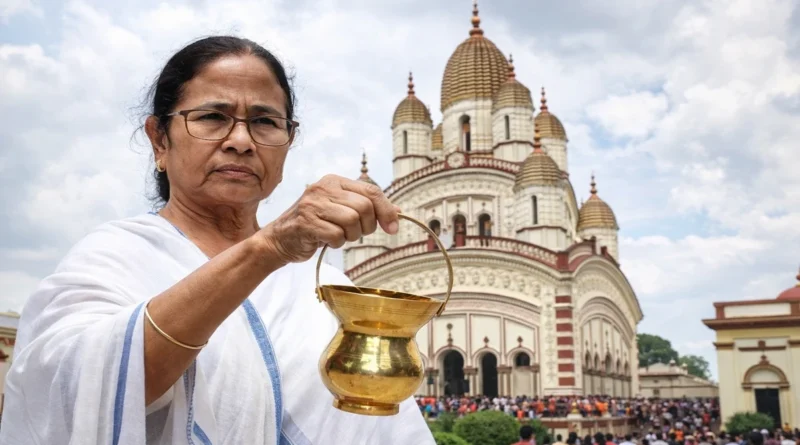
The saying that the one protected by Mahakal can even alter destiny itself reflects the belief in Lord Shiva’s supreme power and his boundless grace toward devotees, enabling them to overcome every obstacle. This line is now being used symbolically in the political context of West Bengal, where Chief Minister Mamata Banerjee appears to be seeking refuge in faith as political challenges mount ahead of the 2026 elections.
There was a time when political upsets seemed unimaginable. Few believed that Narendra Modi could defeat Arvind Kejriwal in Delhi in 2025, especially when Kejriwal himself claimed he was unbeatable. Yet Delhi politics slipped out of Kejriwal’s hands. In Bihar, Lalu Prasad Yadav’s influence faded, and record victories were registered against him. Rahul Gandhi’s political standing has already weakened nationally. Now the question being asked is: what is Narendra Modi planning for 2026 that has left Mamata Banerjee visibly unsettled in Bengal?
Once confident that the BJP could never win Bengal, Mamata Banerjee now appears unsure of her next move. At times she is caught in debates around the Babri Masjid, while at other moments she speaks about Hindu temples. The same kind of confidence Kejriwal once displayed is now being compared to Mamata’s stance—and the country knows how Kejriwal’s story ended. This has led many to wonder whether Mamata Banerjee could face a similar political fate.
Babri, Mahakal, and the Start of Temple Politics in Bengal
With the 2026 West Bengal elections approaching, temple–mosque politics has entered the state’s political landscape. Humayun Kabir, a former TMC leader, laid the foundation stone of a Babri Masjid project and was subsequently expelled from the party. He has since formed his own political outfit, creating fresh troubles for Mamata Banerjee.
Amid this turmoil, Mamata announced the construction of what is being described as the largest Mahakal temple, with work scheduled to begin in the second week of January. She was also seen laying the foundation stone of the Durga Angan complex. Alongside advising Humayun Kabir to uphold secular values, she herself has begun playing what many call the “soft Hindutva” card—attempting to counter the BJP on its own ideological ground.
Echoes of Rajiv Gandhi’s Soft Hindutva Strategy
Mamata Banerjee’s political style is often said to resemble that of her former party, the Congress. Her political grooming took place under Rajiv Gandhi. During his tenure, the Shah Bano Supreme Court verdict was overturned to appease Muslim sentiments. Later, to balance Hindu opinion, the locks of the disputed structure in Ayodhya were opened, an act widely promoted as soft Hindutva.
That period also saw the telecast of Ramanand Sagar’s Ramayan on Doordarshan, reinforcing Hindu cultural imagery. However, the strategy backfired. The BJP escalated the movement, leading to L.K. Advani’s Rath Yatra from Somnath to Ayodhya. In the end, Congress lost support from both Hindus and Muslims, with Muslim voters shifting to leaders like Lalu Prasad Yadav in Bihar and Mulayam Singh Yadav in Uttar Pradesh. Critics now argue that Mamata Banerjee is walking the same political path.
From Avoiding “Jai Shri Ram” to Building Temples
There was a time when Mamata Banerjee was visibly irritated by slogans of “Jai Shri Ram,” even stopping her convoy to confront those chanting it. She frequently criticized the Ram Temple issue. Today, the same leader is actively commissioning temples and invoking “Jai Maa Durga.”
She has laid the foundation stone for the Durga Angan complex in Kolkata, announced the Mahakal temple in Siliguri, and is set to lay the foundation for a bridge at the Hindu pilgrimage site of Gangasagar on January 5. Earlier, she inaugurated the Jagannath Temple in Digha. Clearly, temple construction has become a central theme of her political messaging.
Is the BJP Caught Off Guard?
Opposition parties have targeted Mamata Banerjee, while the BJP finds itself in a delicate position—it cannot openly oppose temple construction. Observers believe Mamata is strategically choosing temple locations to counter BJP’s Hindutva appeal.
The proposed Mahakal temple in Siliguri is particularly significant. Siliguri is the gateway to North Bengal, a region where the BJP has performed strongly in recent elections. The area has a large population of hill communities, tribals, and Gorkhas, for whom Lord Mahakal holds deep religious significance. By announcing the temple just before elections, Mamata is seen as attempting to consolidate these voter groups.
Babri Controversy Shakes the Ground
The Babri Masjid issue has sparked intense reactions in Bengal. Large sums of money are reportedly being collected in its name, and Muslim communities are mobilizing around the issue. This unexpected surge has raised concerns within the TMC about potential cracks in its traditional Muslim vote bank—something Mamata Banerjee may not have anticipated.
Attacks From All Sides
Left parties argue that the turn toward religious politics highlights the TMC government’s failure to deliver on development, industrial growth, and employment. BJP leader Suvendu Adhikari, one of Mamata’s strongest critics, has cited RSS chief Mohan Bhagwat’s statement that governments should not build temples, pointing out that the Ram Temple in Ayodhya was constructed by a trust, not the state.
Union Home Minister Amit Shah has stated that while temple construction is welcome, Mamata’s move has come too late. Adhikari has also accused the government of appeasement, claiming that the location of the Durga Angan project was changed due to objections from local Muslim residents.
The Left alleges that Mamata Banerjee is using soft Hindutva to distract from corruption, scams, and governance failures. According to them, with no achievements to showcase in development or employment, the government has turned to religious symbolism, mirroring the divisive politics of the BJP and RSS. Critics question how a government can justify building temples while simultaneously attending iftar gatherings—calling the entire approach contradictory and politically motivated.
In the run-up to 2026, Bengal has clearly become a stage where faith and politics are deeply intertwined, and the outcome of this high-stakes gamble remains uncertain.