
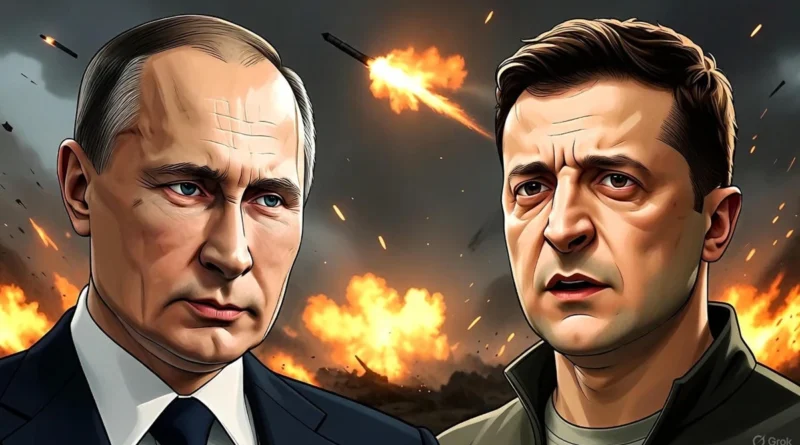
After Alleged Drone Attack Near His Residence, Putin Signals Fierce Retaliation Against Ukraine
Following reports of a massive drone assault allegedly targeting Russian President Vladimir Putin’s residence, Moscow has responded with fury. According to Russian claims, as many as 91 long-range drones were used in the attempted strike, an act Putin has described as cowardly and unacceptable. In response, he has reportedly issued direct orders to the Russian military, making it clear that Ukraine will face severe consequences.
Putin has warned that Russia’s retaliation will be decisive and personal in nature. He indicated that Ukrainian President Volodymyr Zelensky would be a key focus of Russia’s response, suggesting that any attack on Russian leadership would be answered by targeting Ukraine’s highest authority. Within hours of the alleged drone incident, Russia appeared to demonstrate its intent through intensified military action.
Historically, Putin has built a reputation for responding harshly to what he views as betrayal or aggression. True to that pattern, Russian forces launched heavy strikes on several Ukrainian cities soon after the incident. The city of Kharkiv (Orkiv, as cited in reports) came under intense bombardment, resulting in significant casualties. Similar attacks were reported from the Donetsk region, where widespread destruction and multiple deaths were also confirmed.
Amid the escalating conflict, Russia’s Defense Ministry announced a major strategic move: the deployment of advanced ballistic missile systems in Belarus. For the first time, official images of these systems were released. The Oreshnik missile system has reportedly already arrived in Belarus, with plans to station a total of ten such systems there. Belarusian defense officials stated that these missiles have a range of up to 5,000 kilometers, putting much of Europe within striking distance. Russia claims the missiles could reach Polish airspace in just 11 minutes and NATO headquarters in approximately 17 minutes.
Meanwhile, Ukraine has continued to face aerial attacks. In the southern port city of Odesa, Russian drones struck a residential building and parts of the power grid late Tuesday night. Six civilians, including three children, were injured. Local authorities reported damage to multiple buildings, while energy company DTEK confirmed that two of its facilities were badly hit. Officials noted that ten power substations in Odesa have already been damaged during December alone. Ukrainian authorities described these attacks as deliberate attempts to terrorize civilians by targeting essential infrastructure.
On the other hand, Russia insists that Ukraine was responsible for the attempted drone strike near Putin’s residence in northwestern Russia. Ukrainian officials have firmly denied the accusation, calling it a provocation designed to derail any progress toward peace talks. A senior Russian Air Force officer claimed the drones were launched from Ukraine’s Sumy and Chernihiv regions.
Tensions escalated further after Belarusian President Alexander Lukashenko confirmed that ten Oreshnik missile systems would be permanently deployed in his country. Putin, during a meeting with top military commanders, announced that these systems are now fully operational. He also reiterated Russia’s intention to seize additional Ukrainian territory, signaling that the conflict could intensify even more in the coming months.
Although Ukraine has rejected all allegations related to the drone attack on Putin’s residence, the fallout from the claims has sharply increased regional instability. With military deployments expanding and rhetoric hardening on both sides, the war appears to be entering an even more dangerous phase.