
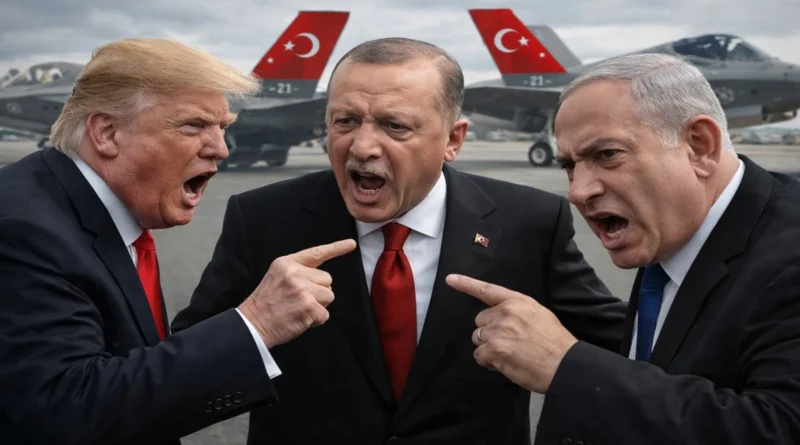
Trump’s Turkey Pivot Shakes Israel: F-35 Remark Sparks Global Debate
A surprising statement from the United States has triggered fresh geopolitical ripples across the world, especially in the Middle East. Standing alongside Israeli Prime Minister Benjamin Netanyahu during a press interaction in Florida, former U.S. President Donald Trump openly praised Turkey and referred to it as a “good friend” of America. What truly caught global attention, however, was Trump’s remark that Washington is seriously considering supplying Turkey with advanced F-35 fighter jets.
This comment came as a shock to Israel, given its long-standing tensions with Turkey. Over the years, Ankara and Tel Aviv have found themselves on opposite sides of key regional issues, including Syria, Gaza, and the Eastern Mediterranean. Trump’s sudden warmth toward Turkey, expressed right in front of Netanyahu, has reignited questions about U.S. strategy and Trump’s broader political calculations.
The statement is even more striking when viewed in context. In 2019, the United States had removed Turkey from the F-35 program after Ankara purchased the Russian-made S-400 missile defense system, a move that angered Washington and raised concerns within NATO. Trump’s apparent change in tone now raises serious questions about whether U.S. policy toward Turkey could be heading for another dramatic shift.
F-35 fighter jets are among the most sophisticated combat aircraft in the world, and Israel has long viewed its access to such technology as crucial to maintaining military superiority in the region. Israeli officials fear that if Turkey were to receive these jets, the regional balance of power could tilt significantly. This concern is particularly acute in conflict-prone areas like Syria, where enhanced Turkish air power could alter military dynamics in ways Israel finds unacceptable.
The rivalry between Israel and Turkey goes far beyond advanced weaponry. Their tensions are rooted in competing strategic interests across multiple theaters, including Syria, Gaza, and the wider Eastern Mediterranean. These frictions were visible as recently as December 23, when Israeli Prime Minister Netanyahu, during a trilateral meeting with Greece and Cyprus, issued a direct warning aimed at Turkey.
Adding another layer to the dispute, Israel has recently recognized Somaliland, a region whose international status remains disputed. This move has angered Turkey, Pakistan, and several Muslim-majority countries. Analysts believe Israel’s decision is part of a broader strategy to strengthen its influence near the Red Sea and counter Turkey’s growing presence in Africa, where Ankara has steadily expanded its military and diplomatic footprint.
Turkey already holds considerable influence in the region and has been actively working to enhance its military capabilities and strategic reach. With Israel now stepping more assertively into areas that overlap with Turkish interests, the regional equation appears to be shifting. Trump’s remarks on Turkey and the F-35 program have only intensified the sense that long-standing alliances and rivalries in the Middle East may be entering a new and uncertain phase.