
Shockwaves Worldwide as US Action in Venezuela Sparks Debate Over Power, Politics, and Profits
In a move that stunned the international community, the United States carried out air strikes in Venezuela and captured President Nicolás Maduro, triggering both sharp criticism and open praise across the globe. Speaking at a press conference at his Mar-a-Lago resort in Florida, US President Donald Trump openly applauded the operation, calling it one of the most dramatic, precise, and powerful displays of American military strength in history.
The operation was widely compared to the 2011 US Navy SEAL raid in Abbottabad, Pakistan, that killed Al-Qaeda leader Osama bin Laden—making it one of the most daring and controversial US-approved missions in recent decades. News of the 63-year-old Venezuelan leader’s capture sent shockwaves through global media, while discussions also began swirling around the potential economic beneficiaries of the action, including tech billionaire Elon Musk.
Why Venezuela’s Upheaval Could Benefit Elon Musk
Beyond oil, Venezuela is believed to sit atop vast reserves of gold—estimated at nearly 10,000 tonnes—buried in regions long affected by conflict and instability. At current market prices, the value of this gold runs into trillions of dollars. Analysts argue that, from a strategic standpoint, gold is far more attractive than oil: oil extraction requires time, damaged pipelines must be repaired, refineries rebuilt, and production can take years to normalize. Gold, on the other hand, is instantly liquid wealth.
Critics claim that once a US-aligned government is installed in Caracas, much of this gold could quickly flow into American and Western banking systems, helping ease debt burdens and stabilize struggling economies. Gold reportedly locked away in London banks for years could suddenly come under US influence—opening the door for major corporate players, including Elon Musk.
Minerals, Not Just Oil, at the Heart of the Crisis
Venezuela’s vice president had earlier hinted that the push for political change was not only about oil, but also about gaining control over critical minerals. Venezuela’s soil is rich in coltan and lithium—resources essential for smartphones, electric vehicles, and advanced battery technology. These minerals are central to Tesla’s supply chain and Musk’s broader ambitions in electric mobility and robotics.
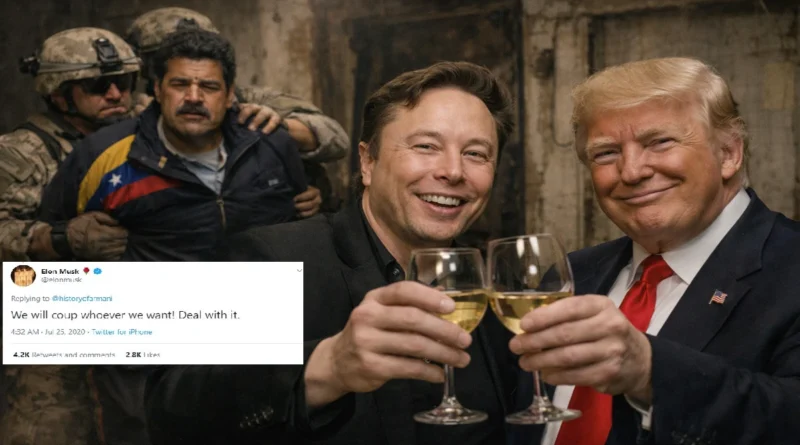
Observers recall that a similar political upheaval occurred in lithium-rich Bolivia a few years ago, after which Musk controversially tweeted words that were widely interpreted as endorsing regime change for resource access. That remark is often cited as reflecting a mindset among powerful corporate and political elites—where strategic resources outweigh democratic principles.
Business Interests Over Democracy?
Elon Musk’s need for affordable battery materials aligns closely with Venezuela’s mineral wealth. This, critics argue, explains his repeated public criticism of Maduro and his apparent alignment with Trump’s hardline stance. In this narrative, Trump brings military and political power, while Musk gains access to minerals vital for future technologies.
According to this view, the Venezuela operation was less about democracy or human rights and more about economics and control. As an old saying goes, money ultimately drives power—and in this case, the alliance between Trump and Musk appears rooted not just in friendship, but in shared business interests.