
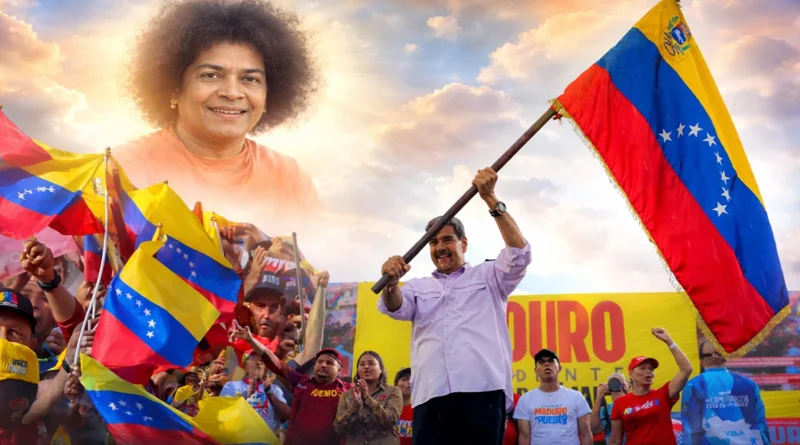
From Bus Driver to Power—and Faith Beyond Borders: The Unusual Journey of Nicolás Maduro
Today, Nicolás Maduro is widely known as one of the world’s most controversial and hardline leaders. Yet long before reaching the pinnacle of power in Venezuela, his life was marked by simplicity, hardship, and grassroots struggle. Maduro’s story is not just political—it weaves together poverty, labor activism, and an unexpected spiritual connection with an Indian guru.
Born on November 23, 1962, in Caracas, Maduro grew up in a modest household. His father was involved in labor unions, which exposed him early to issues of social inequality and workers’ rights. Financial constraints meant Maduro could not complete higher education. Instead, he entered the workforce at a young age, eventually becoming a bus driver in Caracas.
Driving through the capital’s crowded streets gave him a firsthand understanding of everyday struggles faced by ordinary citizens. This experience shaped his political outlook and later drew him into trade union movements and left-wing politics.
After the death of President Hugo Chávez in 2013, Maduro was named his political successor. That same year, he narrowly won the presidential election and assumed office. His presidency, however, soon became associated with deep economic crisis, soaring inflation, food shortages, and prolonged political instability.
A Spiritual Connection That Caught India’s Attention
Beyond politics, one lesser-known aspect of Maduro’s life has drawn particular interest in India. According to reports, the detained former Venezuelan president was a devotee of the late Indian spiritual leader Sri Sathya Sai Baba.
Although Maduro was raised in a Catholic family, he reportedly became a follower of Sai Baba under the influence of his wife, Cilia Flores. In 2005, Maduro and Flores visited India and met Sai Baba in Puttaparthi. At the time, Flores was serving as Hugo Chávez’s lawyer, while Maduro was the Speaker of Venezuela’s Parliament. He later went on to become foreign minister.
Following Sai Baba’s death, Venezuela’s parliament passed a condolence resolution and observed a day of national mourning—an extraordinary gesture that highlighted the depth of this spiritual connection.
Sai Baba’s Presence in the Presidential Office
During Maduro’s presidency, a photograph of Sai Baba was displayed in his official office, and Sai organizations were permitted to operate in Venezuela. Now that Maduro is reportedly being held in a high-security US prison, his past spiritual beliefs have once again come into public discussion.
From a struggling bus driver to a global political figure with unexpected spiritual influences, Nicolás Maduro’s life reflects a complex blend of power, ideology, hardship, and faith—far removed from the image by which he is most commonly recognized today.