
Greenland, Power Politics, and the New Rules of Global Order
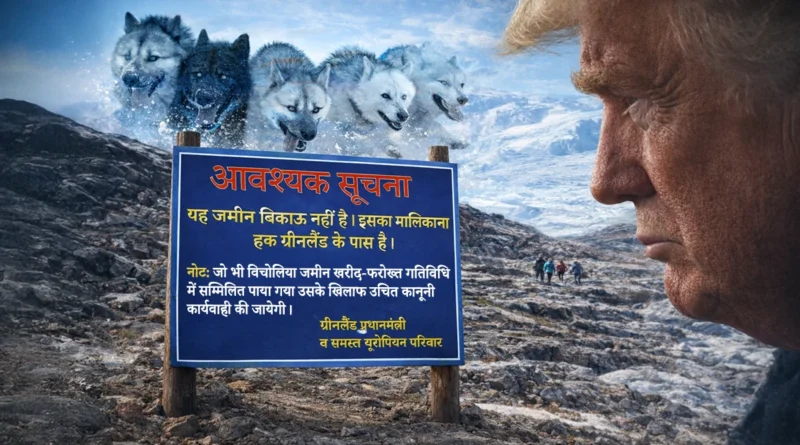
Donald Trump has repeatedly portrayed himself as a leader who has helped halt multiple wars and reduce global conflict. Yet, since the beginning of this year, his actions have told a far more confrontational story. From deploying forces in Venezuela and forcing the removal of its president, to openly threatening military action against Iran, to warning dozens of countries with fresh tariffs, Trump’s approach has blended coercion with claims of peacekeeping. Most recently, after declaring that tensions with Iran had “stabilized,” he abruptly shifted focus toward Greenland—making it clear that nothing short of American control over the island would be acceptable.
Trump’s argument is framed as a matter of national security. He insists that U.S. dominance over Greenland is essential to prevent China or Russia from gaining a foothold there. Critics, however, point out the striking contrast: when Russian President Vladimir Putin claims control over Ukraine as a security necessity, the West calls it authoritarian aggression. When Trump makes a similar argument about Greenland, Washington describes it as strategy, negotiation, or a “deal.” This contrast, many argue, reveals how the rules of global power are being rewritten—not around principles, but around who is making the claim.
A Shockwave From Washington to Brussels
In the early hours of January 17, 2026, while much of Europe slept, Trump issued a statement that sent shockwaves across Western capitals. Naming Denmark, Norway, Sweden, France, Germany, the United Kingdom, the Netherlands, and Finland, he accused these countries of entering Greenland with unclear and potentially dangerous intentions.
Trump announced that unless a comprehensive agreement for the “full and total acquisition” of Greenland was reached, the United States would impose punitive tariffs: 10 percent starting February 1, rising to 25 percent by June 1. These were not threats aimed at adversaries, but at NATO allies—countries that had stood shoulder to shoulder with the U.S. for over seven decades.
This move was not impulsive. At its core was an ego-driven response. These eight European nations had publicly pledged support for Denmark when the U.S. first floated the idea of buying or asserting control over Greenland. By standing together, they had challenged Trump directly—and he chose to retaliate economically.
Troops, Tariffs, and a Message to Allies
To underline their commitment, and in line with NATO principles, these European countries sent troops to Greenland. The message was unmistakable: Greenland was not isolated, and any attempt to strong-arm Denmark would meet collective resistance.
Trump interpreted this as a personal affront. Known for his uncompromising style, he responded with what he often sees as his most effective weapon—tariffs. A 10 percent surcharge was imposed on goods from these countries, with a clear warning that failure to reach a deal favorable to Washington would trigger a hike to 25 percent.
The symbolism was hard to miss. These tariffs were not aimed at rivals like China or Iran, but at close allies who had fought alongside the U.S. in nearly every major conflict since World War II.
Why Greenland Matters So Much
Greenland’s importance lies not in its population or economy, but in its geography. It is one of the eight Arctic-region countries and, while formally part of Denmark, enjoys autonomous status. Nearly 80 percent of its landmass is covered by ice—up to four kilometers thick. But that ice is melting fast. The Arctic is warming nearly four times faster than the rest of the world, and millions of square kilometers of ice have already disappeared.
Beneath that ice lies enormous potential: an estimated 30 percent of the world’s undiscovered natural gas and 13 percent of undiscovered oil, along with gold, platinum, zinc, iron ore, copper, lead, molybdenum, and titanium. It is no surprise that not only the U.S., but also China and Russia, are watching Greenland closely.
During the Cold War, the Greenland–Iceland–UK gap was central to NATO’s naval strategy, allowing surveillance of Soviet submarines entering the Atlantic. For decades, the Arctic remained a frozen buffer zone. Climate change has transformed it into an active strategic theater. Melting ice is opening new sea routes, while advances in hypersonic weapons, missile defense, space-based sensors, and long-range strike capabilities are shrinking distances and reaction times. Greenland has moved from the periphery to the front line of global strategy.
Trillions Beneath the Ice—and Control of Future Trade
Modern power is no longer driven solely by oil, but by minerals critical for semiconductors, batteries, electric vehicles, and advanced weapons systems. Smartphones, electric cars, and fighter jets all depend on these resources—and today, China dominates their supply chains.
American policymakers and investors know this. For them, Greenland’s minerals represent the “oil of the future.” Major figures in global finance and technology, including influential billionaires, are backing mining ventures there. Companies such as KoBold Metals are preparing for large-scale extraction, convinced that the next great resource boom lies beneath Greenland’s ice.
Melting glaciers are also opening new shipping routes, sometimes called the “Polar Silk Road.” These routes could cut travel distances between Asia and Europe by up to 40 percent, bypassing chokepoints like the Suez Canal. In this scenario, Greenland becomes a strategic checkpoint capable of influencing global trade for the next century.
A useful comparison is India’s continued presence on the Siachen Glacier. Despite immense logistical costs and minimal immediate economic value, India holds Siachen because abandoning it could allow future strategic disadvantages. Once such territory is lost, reclaiming it becomes exponentially more expensive. For the U.S., Greenland represents a similar long-term calculation.
America’s Hidden Past Beneath Greenland’s Ice
Few people realize that beneath Greenland’s ice lies the remains of a secret American project from the Cold War. In the 1960s, under “Project Iceworm,” the U.S. planned to build an underground city—Camp Century—connected by thousands of kilometers of tunnels. The goal was to secretly deploy up to 600 nuclear missiles beneath the ice, constantly on the move to evade Soviet detection.
The base even included living quarters, a church, and recreational facilities. But nature intervened. Shifting ice made the project unviable, and it was abandoned, leaving behind infrastructure—and potentially hazardous materials—buried under the ice.
There was more. In 1968, a U.S. B-52 bomber carrying four hydrogen bombs crashed in Greenland, an incident known as “Broken Arrow.” While Trump claims Greenland is unsafe due to external threats, critics argue that some of the greatest risks stem from America’s own past experiments and military accidents.
What Comes Next
Historically, U.S. policy has emphasized maintaining strong alliances within NATO. Yet a growing faction in American politics believes European countries benefit from U.S. military power while resisting American policy leadership. Some even question NATO’s relevance after the collapse of the Soviet Union.
Trump is not dismantling NATO, but under his leadership, the U.S. is clearly trying to reshape the alliance on its own terms. This approach has drawn sharp opposition within America itself, where many view his tactics as reckless and divisive.
Still, supporters argue that Trump will be remembered as a leader who forcefully reasserted American dominance—making the U.S. economically and strategically stronger while pushing the world toward a more America-centered global order. Whether that order leads to stability or deeper confrontation remains an open question.