
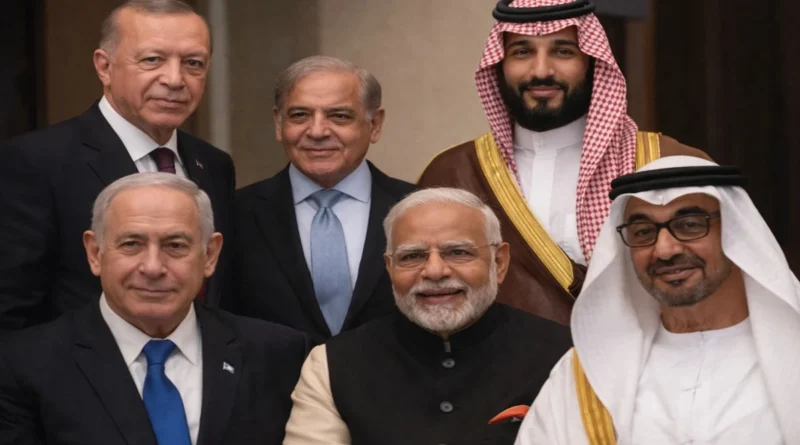
Shifting Alliances: Could a Secular India–UAE–Israel Axis Counter a Rising “Islamic NATO”?
As former US President Donald Trump’s confrontational style continues to strain NATO, the world’s most powerful military alliance appears more divided than ever. At the same time, a very different geopolitical idea is quietly taking shape: a possible military alignment among Pakistan, Turkey, and Saudi Arabia—often described by analysts as a potential “Islamic NATO.”
It is against this backdrop that the sudden, short-notice visit of UAE President Sheikh Mohammed bin Zayed Al Nahyan to India has drawn attention. His stay, lasting less than 24 hours, was widely seen as more than a routine diplomatic engagement. Coming amid tensions between Saudi Arabia and UAE-backed forces in Yemen, and Abu Dhabi’s clear disagreement with Turkey’s Muslim Brotherhood–driven regional policies, the timing of the visit raised strategic questions.
Experts believe behind-the-scenes preparations may be underway to balance the influence of any emerging Islamic military bloc in South Asia and the Middle East. According to this view, a secular strategic alignment involving India, the UAE, and Israel could act as a counterweight to a Pakistan–Turkey–Saudi partnership—each bringing a different strength to the table: Pakistan’s nuclear capability, Turkey’s advanced military technology, and Saudi Arabia’s oil-rich economy.
India already enjoys strong strategic ties with both the UAE and Israel. Within the Middle East, the UAE has emerged as one of Israel’s closest regional partners. The two countries have significantly expanded intelligence cooperation, particularly to counter threats from Iran’s missile and drone networks as well as extremist groups. Their relationship has evolved rapidly: bilateral trade, almost negligible before 2000, rose to nearly $5 billion by 2023–24. Following the Abraham Accords in 2020, embassies were opened, direct flights began, and security and commercial cooperation accelerated.
Israeli technology now plays a role in protecting critical UAE infrastructure such as oil terminals, ports, and airports from cyber threats. Coordination has also increased in air defense systems and counter-drone capabilities. Reports suggest that even during periods of direct Israel–Iran confrontation, the UAE quietly extended support to Israel. Both countries prioritize pragmatic, interest-based foreign policy over ideological alignments and seek to offset the influence of blocs led by Turkey and Qatar.
From a broader geopolitical lens, the signals are becoming clearer. Indian armed forces regularly conduct joint exercises with both the UAE and Israel, reinforcing military interoperability. If these relationships were to evolve into a more structured, secular security framework, it could significantly reshape the balance of power across South Asia and the Middle East.
Economically, the contrast is stark. The combined economies of India, the UAE, and Israel are valued at around $5.6 trillion, nearly double the estimated $2.9 trillion combined economy of a potential Islamic bloc led by Turkey, Pakistan, and Saudi Arabia. In terms of financial resilience, the secular grouping would command far larger foreign exchange reserves. Militarily, India, Israel, and the UAE together field a substantially larger active force and more than 1,000 combat aircraft, including Israel’s fifth-generation F-35 fighter jets.
While these alignments remain informal and evolving, the direction is unmistakable. As global alliances fragment and new power centers emerge, a closer India–UAE–Israel partnership could become a defining factor in regional security—offering a strategic counterbalance to ideologically driven coalitions and reshaping the geopolitical chessboard.