
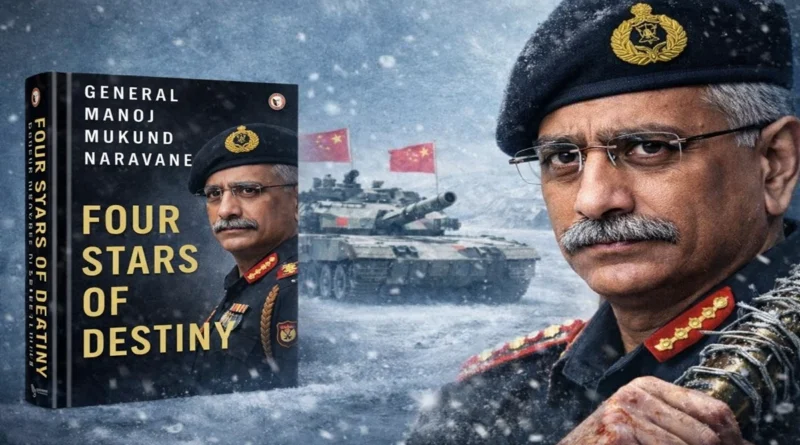
Unpublished Army Chief’s Book Sparks Storm in Parliament, Turns Presidential Address Debate Into Showdown
What is usually a moment of parliamentary decorum—the discussion on the Motion of Thanks to the President’s Address during the Budget Session—descended into sharp confrontation and repeated disruptions after Congress leader Rahul Gandhi raised national security issues by citing an unpublished book by former Army Chief General M.M. Naravane.
Quoting from the unreleased memoir, Rahul Gandhi claimed that four Chinese tanks had crossed into Indian territory during the Doklam standoff. The statement immediately drew strong objections from Defence Minister Rajnath Singh and Home Minister Amit Shah, both of whom intervened to challenge the reference. The Speaker repeatedly cautioned Gandhi, citing parliamentary rules, but the Congress leader continued, forcing multiple adjournments of the House.
Rahul Gandhi maintained that he was attempting to raise serious concerns related to national security and accused the government of avoiding discussion. The ruling side countered sharply, arguing that unverified claims, half-disclosed facts, and references to unpublished material had no place in parliamentary debate and amounted to spreading confusion rather than seeking clarity.
It is rare—but not unheard of—for exchanges in the House to turn this sharp. With the Leader of the Opposition speaking and the Home and Defence Ministers responding in equally firm tones, tempers flared on both sides. At the centre of the confrontation was a single book—one that has not even been released. Yet, its mere mention was enough to provoke strong reactions across the entire ruling coalition.
The Book at the Heart of the Controversy
The book in question is Four Stars of Destiny, the autobiography of former Army Chief General Manoj Mukund (M.M.) Naravane. The title refers to the four-star rank held by an Army Chief, with the book reflecting on leadership, decision-making, and critical moments during his tenure from 31 December 2019 to 30 April 2021.
The obvious question is: what exactly does the book say, why has it not been published, and why did its reference trigger such an intense response in Parliament?
How the Dispute Began
When a book is nearing publication, selected excerpts are often shared with journalists to generate early interest. In the case of General Naravane’s memoir, early attention initially focused on his remarks about the Agnipath (Agniveer) scheme, which was launched in 2022 after his tenure but became a major political issue ahead of the 2024 Lok Sabha elections.
In the book, General Naravane reportedly described the launch of the Agniveer scheme as “surprising” for the Army and “like a bolt from the blue” for the Navy and the Air Force. These remarks triggered political debate, as the opposition accused the government of undermining traditional military recruitment and employment structures for the youth.
Chinese Tanks Near the Kailash Range?
According to a report by The Indian Express, the book was expected to be printed and released by January 2025 but was instead sent for official review, given Naravane’s position as a former Army Chief. The manuscript was forwarded to the Army and the Ministry of Defence, and the review process has now been ongoing for nearly two years.
Meanwhile, The Caravan magazine published a detailed article citing portions of the unpublished manuscript. The article claimed that on the night of 31 August 2020, then Northern Army Commander Lt Gen Yogesh Joshi received an urgent call around 8:15 pm. Four Chinese tanks, accompanied by infantry, were reportedly moving toward Rechin La in eastern Ladakh and had come within a few hundred metres of Indian posts along the Kailash Range.
The account suggests that General Naravane repeatedly contacted political and military leadership seeking clear instructions. According to the text, no explicit orders were given as the Chinese tanks advanced to within about 500 metres of the ridgeline. At around 10:30 pm, the Defence Minister allegedly called with a brief directive: “Do what you think is appropriate.”
Naravane is quoted as describing the situation as extremely precarious.
Was the Galwan Clash Unexpected?
The book further suggests that the Galwan Valley clash of August 2020 was not sudden or unforeseen, but the outcome of weeks of escalating Chinese aggression. It claims that local commanders were insufficiently prepared and may have downplayed the seriousness of the situation.
It also states that several Indian soldiers who had either lost their way or were briefly detained by the PLA—allegedly without food or medical care—were later returned to their bases.
Why Has the Book Not Been Cleared?
The delay in clearing Four Stars of Destiny has raised repeated questions. At a literary festival in October last year, General Naravane was asked why the book had not yet been approved for publication. Responding with a smile, he said he would like to know the answer himself, adding that it was the publisher’s responsibility to seek clearance from the Ministry of Defence and that the manuscript was still under review.
So far, neither the Ministry of Defence nor the Indian Army has issued a clear public explanation on whether there are specific objections to the book’s content.
The Official Secrets Act Angle
According to officials, all government employees—including members of the armed forces—are bound by the Official Secrets Act, both during service and after retirement. Any publication related to their official duties requires prior approvals, depending on the nature and sensitivity of the content.
The fate of General Naravane’s autobiography ultimately hinges on this review process. Until then, the book remains unpublished—but its impact has already been felt, turning a routine parliamentary debate into one of the most heated confrontations of the Budget Session.