
Bangladesh Votes for Change: BNP Surges Back as Tarique Rahman Returns to the Spotlight
After 17 long years in exile, a familiar political name is back at the center of Bangladesh’s power play — and this time, it looks like he’s returning not just to the country, but to the driver’s seat.
Under the leadership of Tarique Rahman, the Bangladesh Nationalist Party (BNP) has clinched a commanding victory in Thursday’s crucial national election. The vote marks the first major electoral exercise since the July 2024 uprising that ended the 15-year rule of former Prime Minister Sheikh Hasina — a tenure often described by critics as firm, centralized, and uncompromising.
A High-Stakes Election in a Nation of 170 Million
According to the Election Commission of Bangladesh, more than 127 million eligible voters were registered in a country of roughly 170 million people. A total of 1,981 candidates contested 299 parliamentary seats across the nation.
As counting stretched past midnight, it became increasingly clear that BNP was edging closer to reclaiming power. With the once-dominant Awami League absent from the race following its fall from power in August 2024, the contest effectively turned into a head-to-head showdown between BNP and Jamaat-e-Islami.
By late Thursday night, unofficial results showed BNP leading in most constituencies — a sign that the political winds had shifted decisively.
“No Time to Celebrate,” Says BNP
Citing unofficial tallies reported by the newspaper Ittefaq, BNP secured 158 seats, while Jamaat-e-Islami captured 41. Other parties managed to win five seats. Of the 299 constituencies, vote counting had been completed in 204 by the time early results were compiled.
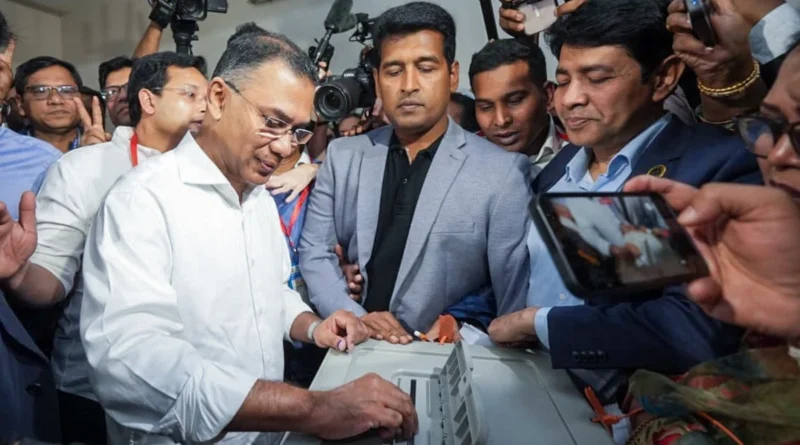
In Bogura, his home district, Tarique Rahman reportedly won convincingly. He secured 216,284 votes, comfortably defeating Jamaat candidate Abidur Rahman, who received 97,626 votes. BNP had earlier announced that if victorious, Tarique Rahman would become Bangladesh’s next prime minister — effectively bringing an end to the 18-month interim administration led by Muhammad Yunus.
Despite the party’s apparent win, BNP leaders struck a measured tone. “This is not the moment for celebration,” a senior figure said, signaling that challenges lie ahead in forming the next government.
Key Wins and Close Contests
In Dhaka, Jamaat-e-Islami President Shafiqur Rahman was unofficially declared the winner in one constituency with 82,645 votes, defeating his BNP rival who polled 61,920.
Meanwhile, BNP Secretary General Mirza Fakhrul Islam Alamgir triumphed in the northwestern district of Thakurgaon with an impressive 234,144 votes. He defeated Jamaat’s Delwar Hossain, who secured 137,281 votes.
In Khulna, however, the contest was tight. Jamaat Secretary General Miah Golam Porwar received 144,956 votes but narrowly lost to BNP’s Ali Asgar Lobi, who polled 147,658.
This 13th parliamentary election also doubled as a referendum on the July National Charter — an ambitious 84-point reform package aimed at reshaping governance after last year’s political upheaval. Voting concluded at 4:30 p.m. local time, with counting beginning almost immediately afterward.
BNP Signals Stability in India-Bangladesh Ties
As the results rolled in, BNP leader Zeba Amina Khan made it clear that regional stability would remain a priority. Speaking about relations with India, she emphasized cooperation over confrontation.
“We are neighbors. We are friends — and we should stay friends,” she said. “Our border is extensive. Any security concern for India is also a concern for us. There are small issues along the border, but these can and should be resolved through dialogue. We have no problem with India, and we hope India continues to work closely with the people of Bangladesh.”
Her remarks appear aimed at reassuring New Delhi that a BNP-led government would not disrupt bilateral ties.
What About Pakistan’s View?
Analysts suggest that the outcome may draw mixed reactions across the region. Experts speaking to Al Jazeera indicated that Pakistan would likely have favored a Jamaat-led government.
Michael Kugelman, Senior Fellow for South Asia at the Atlantic Council, argued that Islamabad would be the only major regional player openly welcoming a Jamaat victory. Meanwhile, Khondokar Tahmid Rejwan, a lecturer in Global Studies and Governance at Independent University, Bangladesh, suggested that even if Jamaat had won, it might have opted for pragmatic engagement with India rather than confrontation.
A Political Comeback Years in the Making
For now, though, the spotlight is firmly on BNP and Tarique Rahman. His return after nearly two decades abroad marks one of the most dramatic political comebacks in the country’s recent history.
Bangladesh has voted, and the message appears clear: the post-uprising chapter is underway. Whether this transition ushers in stability, reform, and smoother regional diplomacy remains to be seen — but one thing is certain, the political landscape of Dhaka has been fundamentally reshaped.