
India’s Jet Engine Leap: A Defining Moment for AMCA and the Future of Indigenous Air Power
When Defence Minister Rajnath Singh recently announced that production of an indigenous fighter jet engine would begin in India next year, it was more than a routine update. It was a signal — one that suggests India is preparing to step into one of the most exclusive and technically demanding arenas in global aerospace: advanced jet engine manufacturing.
Building a fighter aircraft is an extraordinary challenge. Designing and producing the engine that powers it is even harder.
Why Jet Engines Are the Real Test of Aerospace Power
A modern turbofan engine is a marvel of precision engineering. It contains more than 3,000 high-precision components, many of which must operate in temperatures exceeding 1,500°C — hotter than molten lava. These engines rely on cutting-edge superalloys, single-crystal turbine blade technology, and advanced cooling mechanisms that push materials science to its limits.
Only a handful of nations have mastered this domain: the United States, Russia, France, the United Kingdom, and China. India now appears determined to join that elite circle.
The 240 kN Proposal: More Than a Licensing Deal
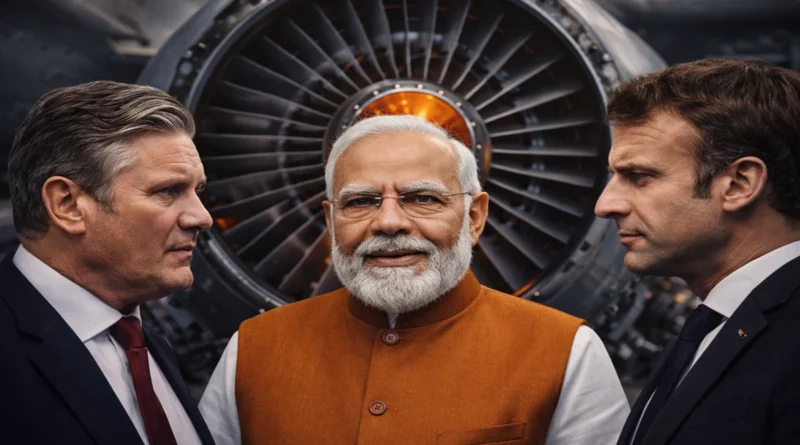
Recent developments have added momentum to that ambition. The CEO of Rolls-Royce met with Prime Minister Narendra Modi, sparking attention in strategic circles. Beyond optics, what stands out is the substance of the reported proposal: manufacturing advanced jet engines in India with full technology transfer and shared intellectual property rights.
The offer reportedly begins with engines in the 120 kilonewton (kN) thrust category for initial integration, with a roadmap to scale up to 240 kN in the future.
This is not a conventional “assemble-under-license” arrangement. It is structured as a co-development model — meaning Indian engineers would be directly involved in design, development, and technological refinement. If realized, this would mark a significant departure from past models where India primarily manufactured under foreign design control.
A Massive Boost for AMCA
At the heart of this engine push lies India’s fifth-generation fighter program — the Advanced Medium Combat Aircraft (AMCA). Conceived as the backbone of India’s future air power, AMCA is expected to feature stealth characteristics, supercruise capability, high payload capacity, and extended operational range.
Such capabilities demand a powerful and efficient engine. High thrust is essential not only for speed but also for sustaining stealth operations without afterburners — a critical requirement for modern air combat.
If India succeeds in achieving engine output in the 240 kN class, AMCA would not just be regionally competitive — it could emerge as a formidable global contender.
Where the GE F414 Fits In
India has already entered into agreements with General Electric for local production of the F414 engine, a powerplant slated for platforms like the Tejas Mk2. That partnership marked an important step in expanding domestic manufacturing capability.
However, the proposed collaboration with Rolls-Royce represents a different scale of ambition. While the F414 deal strengthens production and integration capacity, the new offer aims at deeper design ownership and long-term strategic autonomy in engine technology.
What About the Kaveri Program?
India’s indigenous jet engine effort, the Kaveri program, has faced delays and technical hurdles over the years. Yet, the renewed focus on high-thrust engines and co-development models could potentially breathe fresh direction into India’s long-standing aspiration for full propulsion independence.
The future of the Kaveri initiative may well depend on how successfully India absorbs, adapts, and advances next-generation engine technologies through these international partnerships.
A Strategic Inflection Point
Jet engines are often described as the crown jewel of aerospace engineering — the final frontier that separates advanced aviation powers from aspiring ones. If India manages to transition from licensed production to genuine co-development with intellectual property participation, it would mark a structural shift in its defence-industrial base.
The coming years will determine whether this ambition translates into sustained technological capability. But one thing is clear: India’s engine program is no longer just about powering aircraft. It is about powering strategic autonomy.