
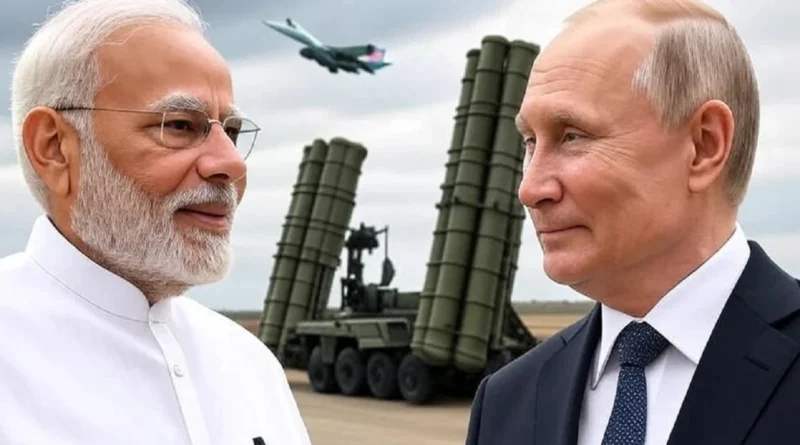
India Eyes a Fifth-Generation Edge: Is the Sukhoi Su-57 the IAF’s Next Big Leap?
India is steadily sharpening the teeth of its air power. As regional security equations evolve and aerial threats grow more sophisticated, New Delhi appears ready to take a decisive step toward strengthening the Indian Air Force (IAF). At the heart of this discussion is the possible induction of a fifth-generation stealth fighter—an aircraft designed not just to compete, but to dominate.
And leading the race, by most accounts, is Russia’s Sukhoi Su-57.
Why a Fifth-Generation Fighter Now?
The urgency is not without reason. India’s security planners are closely watching the rapid modernization of the Chinese air fleet. China already operates advanced fifth-generation platforms such as the Chengdu J-20 and the Shenyang J-35, both of which are operational. Reports suggest that Beijing has also promised to extend access to some of these advanced capabilities to Pakistan.
This shift in the regional air balance has triggered intense deliberations within India’s Ministry of Defence and the IAF. The consensus appears to be clear: India cannot afford to lag behind in the fifth-generation race.
Post-Rafale, the Next Frontier
Following the recent approval of the Rafale jet deal with France, India is now preparing to formalize discussions around acquiring a stealth fighter aircraft. While the Rafale strengthens India’s 4.5-generation capabilities, a fifth-generation platform would introduce a new spectrum of warfare advantages—stealth, supercruise, advanced avionics, sensor fusion, and superior network-centric combat abilities.
In this context, the Sukhoi Su-57 has emerged as India’s preferred interim option.
The AMCA Timeline: A Decade Away
India is developing its own indigenous fifth-generation fighter, the Advanced Medium Combat Aircraft (AMCA). However, officials estimate that the aircraft may take close to a decade to become operationally ready.
That gap presents a strategic vulnerability. To bridge it, the Su-57 is being viewed as a stopgap solution—an aircraft that could provide India with fifth-generation capabilities while the AMCA program matures.
The American Option—and Its Complications
There has also been discussion around the American F-35 Lightning II. However, this option appears to be receiving limited traction.
The reason? Operational restrictions.
India is wary of the stringent conditions often attached to U.S. defense exports. Sources point to the example of Pakistan’s fleet of General Dynamics F-16 Fighting Falcon jets. The United States reportedly maintains tight oversight over their use, including monitoring flight operations and deploying American engineers for maintenance at Pakistani air bases.
If similar restrictions were applied to India’s potential acquisition of the F-35, it could limit operational sovereignty. One key concern is weapons integration. India currently equips its Sukhoi Su-30MKI fleet with the indigenous BrahMos missile—a powerful combination demonstrated in missions such as Operation Sindoor. If U.S. restrictions prevent integration of Indian-origin weapons, India could be forced to rely on expensive Western munitions.
For a country that prioritizes strategic autonomy, such constraints could prove unacceptable.
Strategic Autonomy vs. Technological Access
At its core, the debate is not merely about choosing a fighter jet. It is about balancing technological superiority with operational independence.
The Su-57 offers familiarity in terms of Russian-origin platforms already in service with the IAF. It may also allow greater flexibility in integrating Indian systems and weapons. Meanwhile, the F-35, though technologically advanced, comes with the prospect of dependence on U.S. regulatory and logistical frameworks.
For India, the choice reflects a larger doctrine: strengthening its arsenal without compromising sovereignty.
The Road Ahead
As regional dynamics intensify and air power becomes central to deterrence, India’s move toward a fifth-generation fighter seems less like an option and more like a necessity. Whether the Su-57 ultimately joins the IAF fleet remains to be seen, but one thing is certain—India is preparing for a future where air superiority will define strategic dominance.
And in that future, stealth may well be the sharpest weapon of all.