
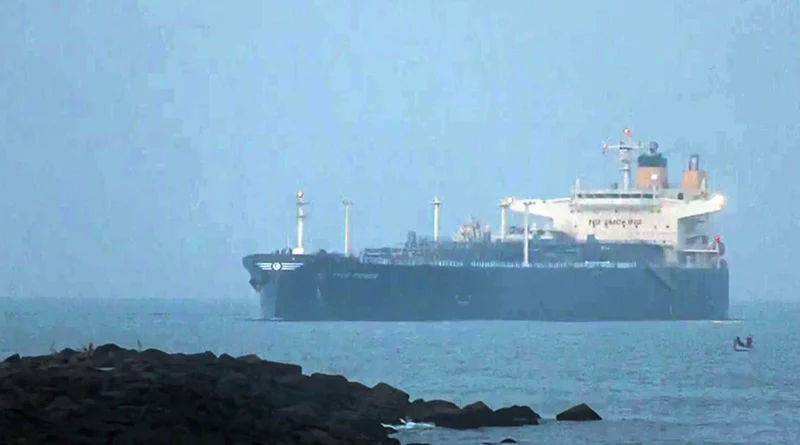
“Turn Back”: Iran Sends Strong Message from Strait of Hormuz, Forces Karachi-Bound Ship to Return
In a statement, authorities said the container ship “Selene” was turned back by the naval forces of the Islamic Revolutionary Guard Corps (IRGC) for failing to follow legal protocols and for not having proper authorization to pass through the Strait of Hormuz. The statement further noted that any vessel wishing to transit through this strategic waterway must maintain full coordination with Iran’s maritime authorities.
Amid the intensifying conflict in West Asia, a significant development took place on Wednesday when Iran reportedly forced a Karachi-bound ship to turn back after it was denied permission to pass through the strategically important Strait of Hormuz. The information was shared in a statement by the Iranian Embassy in Kabul.
According to the statement, the container vessel “Selen” was sent back by the naval forces of the Islamic Revolutionary Guard Corps (IRGC) for failing to comply with legal protocols and for not obtaining authorization to transit through the Strait of Hormuz. The statement further emphasized that all ships passing through the waterway must maintain full coordination with Iran’s maritime authorities.
The Islamic Revolutionary Guard Corps Navy also confirmed the intervention, stating that the vessel had not followed required legal procedures. In a statement, Rear Admiral Alireza Tangsiri said the ship was turned back because it had not secured permission to cross the strait. He added that vessels must coordinate with Iranian maritime authorities before navigating the route.
According to the latest data from Equasis, the ship SELEN (IMO: 9208459) is a small feeder container vessel registered in Saint Kitts and Nevis and managed by Dubai-based company Exceed Oceanic Trading LLC.
Meanwhile, Iranian lawmaker Alaeddin Boroujerdi told the state broadcaster Islamic Republic of Iran Broadcasting (IRIB) that the move signals the emergence of a new sovereign control regime in the Strait of Hormuz after decades. He also said that Iran’s ability to charge some vessels a transit fee of around $2 million for crossing the strait demonstrates the country’s growing influence in the region.
Earlier, Donald Trump had extended the deadline given to Iran to reopen the Strait of Hormuz and stated that the United States would delay a potential strike on a power plant for another five days. Trump announced the decision on his social media platform Truth Social just hours before the original deadline was set to expire.