
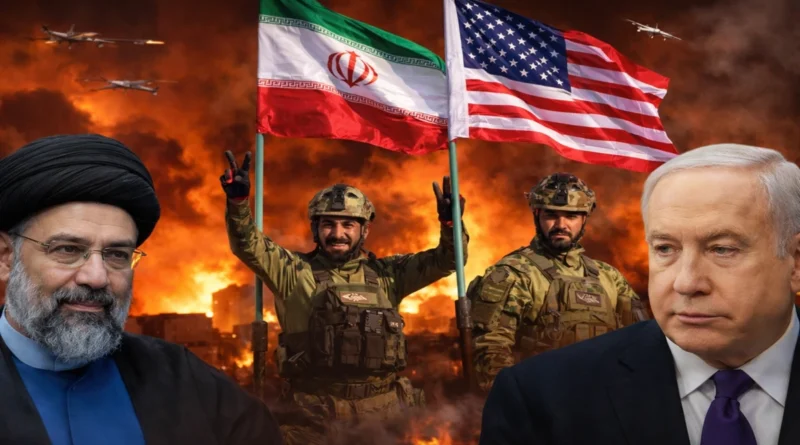
Amid War Tensions, Plans to Push U.S. Out of Iraq — Is a ‘Greater Iran’ Taking Shape
A drone operated by the Islamic Resistance in Iraq targeted two helicopters stationed at a location and reportedly managed to strike one of them during the attack.
Amid rising tensions in the region, new claims suggest that the strategic balance in Iraq may be shifting, with some analysts arguing that while Israel once spoke about the idea of a “Greater Israel,” developments on the ground appear to indicate growing influence from Iran instead.
According to reports circulated by Iranian state media outlet Press TV, a video has surfaced allegedly showing a drone operation targeting a U.S. military installation in Iraq. The footage is said to have been released by the Islamic Resistance in Iraq and reportedly shows the U.S.-operated Victory Base Complex in Baghdad. In the video, a drone equipped with a camera is seen capturing detailed images of the base. It first focuses on an American air defense system before recording an explosion. The drone then moves toward another area where two U.S. Air Force helicopters are stationed, and one of them is reportedly struck during the attack.
The video was reportedly released by Popular Mobilization Forces (PMF), also known as Hashd al-Shaabi. The group, which operates in Iraq, has increasingly targeted U.S. military bases in the country amid the broader regional conflict involving Iran, the United States, and Israel. According to various claims, these actions are part of an effort to pressure American forces to withdraw from Iraq.
The PMF was formed in 2014 following a religious decree issued by Ali al-Sistani to mobilize forces against Islamic State (ISIS), also known as Daesh. The group played a significant role in fighting and eventually pushing ISIS out of large parts of Iraq. After the conflict, the PMF was granted official recognition as part of Iraq’s security forces and now operates under the authority of the Iraqi prime minister.
Since then, critics have argued that Iran has significantly expanded its influence in Iraq. Religious and cultural ties also play a role in this relationship. Iraq hosts two of the most important Shia holy cities—Karbala and Najaf. The shrine of Ali ibn Abi Talib is located in Najaf, while the shrine of Husayn ibn Ali is in Karbala. These sites hold immense significance for Shia Muslims worldwide, especially those from Iran.
Every year, millions of pilgrims travel to Iraq for the Arbaeen pilgrimage. In the past, ISIS carried out several attacks targeting this pilgrimage in an attempt to disrupt it. However, the Popular Mobilization Forces, with support from Iran, helped secure the pilgrimage routes and ensured the safety of pilgrims—something Iraqi forces alone struggled to manage at the time.
This cooperation strengthened ties between Iran and groups operating within Iraq. Today, the PMF is seen by some analysts as backing Iran’s position by increasing pressure on U.S. forces stationed in the country. Before the current conflict escalated, many experts believed that if the United States were to launch a major ground operation against Iran, it might do so through Iraq. However, the growing activity of groups like the Popular Mobilization Forces is now seen as complicating such plans.
Recent claims even suggest that U.S. and NATO forces may be gradually reducing their presence in Iraq. If accurate, such developments would mark a significant shift in the regional power dynamics, especially at a time when tensions across West Asia remain extremely high.