
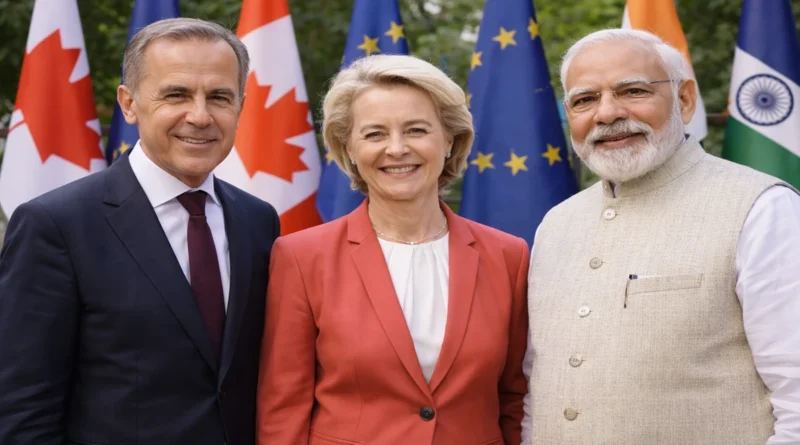
As Trump’s Trade Confrontation Shakes Alliances, Europe and Canada Turn to India for Stability
For countries whose economies have depended on the United States for decades, a pressing question has emerged: how do they adjust to a White House led by Donald Trump, whose approach is increasingly unpredictable and openly confrontational? Amid the disruption created by Trump’s policies, this dilemma has become a multi-billion-dollar concern for governments and businesses alike.
Trump’s aggressive diplomacy and his tendency to use tariffs as a political weapon have unsettled even America’s closest allies. Instead of reinforcing partnerships, this strategy has pushed many countries to look elsewhere for reliability and long-term certainty. This week, Europe and Canada delivered a clear and decisive response—by actively diversifying their export markets and aligning themselves with partners they view as more stable. Their first major stop: India.
The European Union’s move to finalize what is being described as its largest-ever trade agreement with India has come as a sharp setback for Trump. It highlights a growing global realization that Washington’s hardline trade policies and punitive tariffs have left the U.S. increasingly uncomfortable and isolated in a rapidly reshaping economic order.
Did Trump’s Policies Accelerate the India–EU Deal?
Comments by U.S. Treasury Secretary Scott Bessent on the India–EU Free Trade Agreement (FTA) suggest that Washington is now acutely aware of this shifting ground. Speaking to CNBC, Bessent did not lash out, but his tone reflected frustration. He remarked that European partners seemed unwilling to align with the U.S., largely because they were focused on securing a trade deal with India.
Bessent also accused Europe of prioritizing commercial interests over geopolitical concerns such as the war in Ukraine, pointing to India’s close ties with Russia and its continued purchase of Russian oil. However, critics argue that this overlooks a fundamental reality: nations are reluctant to remain dependent on an uncertain partner or operate under constant pressure. Trump’s repeated threats—ranging from punitive tariffs to provocative statements about Greenland—have only deepened European unease.
For the European Union, these factors appear to have provided the final push to conclude a trade agreement with India—talks that had dragged on for nearly two decades. South Asia analyst Michael Kugelman summed it up succinctly on social media, noting that the “Trump factor” clearly helped bring the deal across the finish line. According to him, this agreement goes far beyond cushioning the impact of U.S. tariffs; it cements a broader, rapidly expanding partnership between India and Europe.
Why This Deal Matters for India
Calling the India–EU Free Trade Agreement the “mother of all trade deals” is not an exaggeration. Together, the two sides account for around 25% of global GDP and nearly one-third of worldwide trade. The agreement, expected to be formally signed early next year, could significantly boost India’s exports of labor-intensive goods—sectors that have been hit hard by Trump-era tariffs of up to 50%.
Industries such as textiles, gems and jewelry, footwear, and other manufacturing segments stand to gain the most. On the European side, the deal offers substantial benefits as well, with tariffs set to be eliminated or reduced on 96.6% of EU exports across its 27 member states.
Importantly, the EU has shown flexibility by respecting India’s concerns over politically sensitive areas. India’s dairy and agricultural sectors—often a sticking point in trade negotiations—have been largely kept outside the scope of the agreement, ensuring protection for domestic farmers.
In essence, as the global trade landscape realigns in response to U.S. unpredictability, India has emerged as a key alternative—one that offers scale, stability, and strategic balance. The India–EU trade pact not only reflects changing economic priorities but also signals a broader shift in how the world is recalibrating partnerships in the Trump era.