
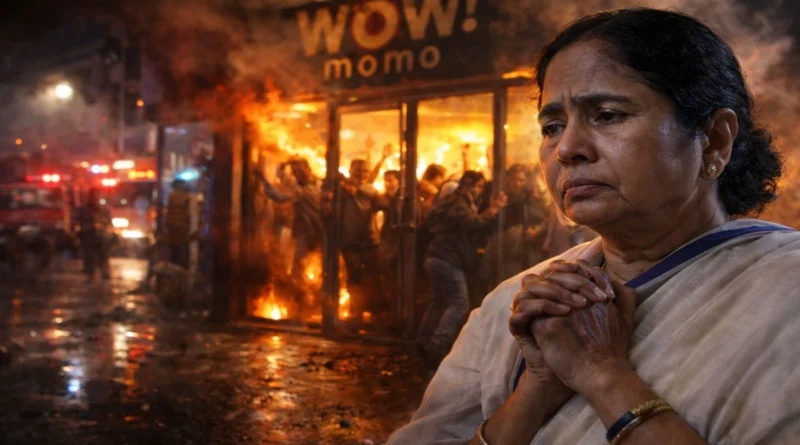
Behind the Shine of Big Brands: Kolkata Warehouse Fire Exposes a Grim Reality of Negligence and Systemic Failure
Shiny billboards, eye-catching advertisements, and viral social media trends often help companies build a glossy brand image. But the harsh reality behind these brands usually comes out only when tragedy strikes. A devastating fire in Kolkata has once again peeled back that curtain, revealing serious questions about safety, negligence, and systemic failure.
The Incident: A Night That Turned Into a Nightmare
In the early hours of 28 January, around 3:00 AM, a sudden fire broke out near Ruby Crossing in the Anandapur area of Kolkata. What began as a blaze in a single warehouse quickly spiraled out of control, engulfing two large godowns within minutes. One belonged to Pushpanjali Decorators, while the other was a leased warehouse used by Wow! Momo, a popular fast-food chain commonly seen on food delivery apps.
The intensity of the fire was so extreme that even days later, authorities have struggled to identify the victims. According to officials, the bodies were burnt beyond recognition, leaving behind only skulls and large bones. As reported by media outlets, police and disaster response teams are now forced to count skulls and bone fragments just to estimate how many people lost their lives.
The fire, which actually started on 26 January in South 24 Parganas, has so far claimed at least 21 lives, with 13 additional bodies recovered from the debris. Police say 28 people are still missing, raising fears that the death toll could rise further. This incident is now being described as Kolkata’s third-deadliest fire tragedy, after the AMRI Hospital fire in 2011 (89 deaths) and the Stephen Court fire in 2010 (43 deaths).
How Did the Fire Spread So Rapidly?
Both warehouses, located in Nazirabad, Anandapur, were built extremely close to each other. At the time of the incident, around 37 people were present across both facilities—some working, others asleep.
Preliminary investigations suggest that the fire originated in Pushpanjali Decorators’ godown. While the exact cause remains unknown, the nature of the materials stored there turned a spark into an inferno. The warehouse contained plastic flowers, wood, fabric, paint, furniture, and various chemicals—all highly flammable. Once the fire started, these materials caused it to spread violently within moments.
The heat and thick smoke gave workers no chance to escape. Soon, the flames crossed over to the neighboring Wow! Momo warehouse, which stored packaging materials, plastic items, cold drink bottles, and other storage goods. Together, the flammable contents of both warehouses transformed a 30,000–35,000 square-foot area into a massive tinderbox.
Identifying the Dead: A Forensic Challenge
According to reports, only three people survived, all of whom were employees at the Wow! Momo warehouse. Those trapped inside the Pushpanjali Decorators godown were unable to escape. Some collapsed while trying to flee, while others simply lost their way in the smoke.
Forensic experts have stated that DNA identification will be extremely challenging due to the severe charring of the bodies. In many cases, genetic material inside the body gets destroyed by intense heat. However, experts remain cautiously hopeful. Long bones and teeth tend to withstand high temperatures better and may still preserve DNA.
The head of a medical college’s forensic department explained that teeth are particularly reliable, as the enamel protects the inner pulp where DNA is stored. Similarly, long bones can survive prolonged exposure to heat. Police officials confirmed that DNA from various body parts will be matched with skulls to determine whether the remains belong to the same individual or different victims, helping establish accurate identities and notify families.
Safety, Accountability, and Growing Questions
Investigations by police and forensic teams indicate that the fire spread from the adjacent decorator’s warehouse. Wow! Momo has clarified that its warehouse was rented, and the building owner also owned the decorator godown where the fire began.
Despite this clarification, uncomfortable questions remain. Should a large, well-known brand store its goods in a facility without a proper fire safety audit? Reports suggest that licenses and no-objection certificates existed mostly on paper, while ground-level safety measures were grossly inadequate.
So far, 13 confirmed deaths have been acknowledged, but critics warn that unless fire safety in industrial areas is taken seriously, similar tragedies will continue—each time at the cost of human lives hidden behind famous brand names.
Curfew, Political Tensions, and Court Intervention
Ahead of a proposed visit by Leader of Opposition Suvendu Adhikari and other BJP leaders, authorities imposed a curfew in the area, banning public movement. Adhikari has approached the Calcutta High Court, seeking permission to visit the site and lead a march from a nearby temple. Sources indicate that the matter may be heard by Justice Shubhra Ghosh.
Why the Confusion Over Death Numbers?
The uncertainty surrounding the death toll has sparked controversy. West Bengal-based YouTuber Path Chatterjee has claimed that more than 50 people may have died. This raises a troubling question: would the reaction be the same if such an incident had occurred in another state? For instance, if 50 people had burned alive in Uttar Pradesh, would the response have been quieter—or far more explosive?
Officially, the West Bengal government confirms recovery of 23 bodies, while another 22–23 people remain unaccounted for. Search operations are still ongoing.