
Behind the Shock and Awe: Is the World Missing America’s Bigger Economic Game?
From launching aggressive actions against Venezuela to intercepting a ship flying the Russian flag in international waters and bringing it to the United States, from openly floating the idea of taking control of Greenland—going so far as to warn NATO—to imposing arbitrary tariffs on trade with Iran, Donald Trump’s presidency has been anything but predictable. In the short span since taking office, Trump may or may not have fulfilled the promise of making America “great again,” but he has certainly succeeded in startling the world with bold, unconventional, and often controversial decisions.
Yet, as the old saying goes, appearances can be deceptive. What the world sees may not be the full story—and what truly matters may be unfolding quietly behind the curtain. Many analysts believe that Trump’s loud, headline-grabbing moves are carefully designed to draw attention away from a much deeper, more consequential plan.
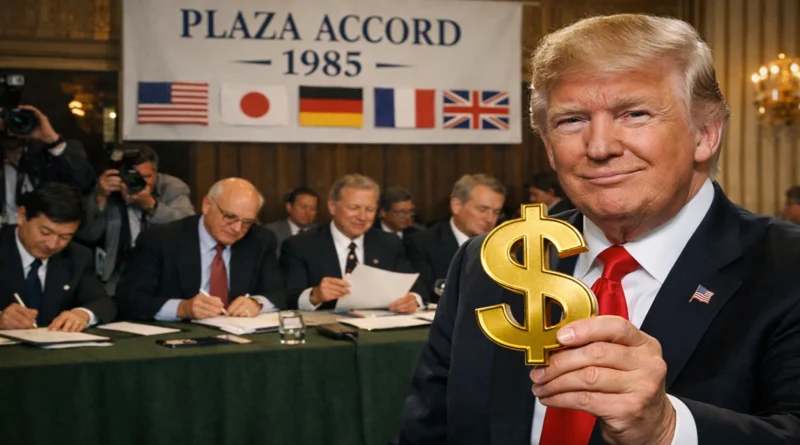
To understand this, one must look back at history—specifically at landmark global financial agreements such as the 1985 Plaza Accord, a deal that reshaped currency markets and redefined economic power. Now, whispers are growing that something even more disruptive could emerge in 2026. This discussion is not just about politics; it blends historical precedent, economic strategy, and a hidden geopolitical power play.
Let’s start at the beginning.
The Origins: The Bretton Woods Agreement
Around 75 years ago, in 1944, the world stood at a pivotal moment. The United States at that time resembled what China is today—a global manufacturing powerhouse. By 1945, nearly 50% of the world’s goods were being produced in the US alone. Seeking to cement its dominance and grow even wealthier, Washington introduced a plan that would later be known as the Bretton Woods Agreement.
The core objective of this agreement was simple yet revolutionary: to make the US dollar the world’s primary reserve currency. America pressured its allied nations to peg their currencies to the dollar. In return, the US promised that these countries could convert their dollar reserves into gold at a fixed rate whenever they wished. Effectively, the dollar was as good as gold.
This promise transformed a simple piece of paper into a symbol of unquestioned value overnight. As global trade increasingly shifted to dollar-based transactions, demand for the US currency skyrocketed.
However, by 1971, the US had printed dollars on a massive scale—far exceeding the gold reserves it held. When countries that were part of the Bretton Woods system began demanding gold in exchange for their dollars, the US found itself unable to honor its commitment. Facing this crisis, President Richard Nixon made a historic decision on August 15, 1971: he ended the dollar’s convertibility into gold.
Despite this, the dollar retained its global dominance. The US maintained its influence by offering lower tariffs, investing capital worldwide, and using its economic leverage to keep the dollar indispensable. But there was a cost. Once the global manufacturing hub, the US saw its manufacturing sector’s contribution to GDP fall from around 25% in the 1940s to just about 10% today—largely blamed on an overly strong dollar.
The 1985 Plaza Accord: A Calculated Currency Reset
In 1985, the United States joined forces with France, Germany, Japan, and the United Kingdom to address growing global economic imbalances. The solution was bold: deliberately weaken the US dollar.
The Plaza Accord became a turning point in global economic history. Coordinated action by central banks caused the dollar to fall nearly 4% in a single day and almost 50% over the next two years. This made American exports cheaper and revived parts of the manufacturing sector. However, it also made imported goods more expensive for American consumers—a phenomenon later termed “imported inflation.”
Stock markets surged, though much of this rise reflected currency effects rather than genuine economic growth. In Japan, a stronger yen fueled a massive boom in equities and real estate. Ultimately, the Plaza Accord was not merely an economic adjustment; it was a strategic move by the US to reduce the real burden of its debt—shifting the cost onto global investors and savers.
Trump’s Alleged “Mar-a-Lago Plan”
Fast forward to today, and Trump’s economic vision is being described by some as a modern reincarnation of the Plaza Accord—dubbed the “Mar-a-Lago Plan,” or even a “mega plan.”
The first step of this strategy is tariffs. Reciprocal tariffs are imposed on all countries, regardless of whether they are allies or adversaries. These measures, while appearing abrupt and aggressive, are largely tactical. The underlying theory is that tariffs force countries to the negotiating table. Once negotiations begin, the US can push its broader agenda.
At that point, America would propose a new Mar-a-Lago-style accord—one aimed at reshaping the existing world order, much like Bretton Woods once did. Countries would be pressured to dismantle trade barriers, allowing US goods to enter foreign markets at competitive prices. Simultaneously, the value of the dollar would be deliberately weakened to make domestic manufacturing economically viable again.
Why a Weaker Dollar Matters
A falling dollar, in this framework, is not an accident—it is a calculated move. Economists describe this as a form of “soft default.” Rather than outright failing on its obligations, the US reduces the real value of what it owes.
With an annual deficit of around $1.8 trillion and total debt nearing $36 trillion, the US government faces enormous fiscal stress. By allowing the dollar to depreciate by 30–50%, the real burden of this debt can be significantly reduced. The same nominal amount would be repaid—but in a weaker currency.
The trade-off is steep. Such a strategy would erode the purchasing power of the American middle class, effectively asking ordinary citizens to absorb the pain in order to stabilize the government and the banking system.
In short, while the world remains focused on Trump’s dramatic gestures and confrontational headlines, the real story may lie in a carefully engineered economic reset—one that could redefine global power structures in the years to come.