
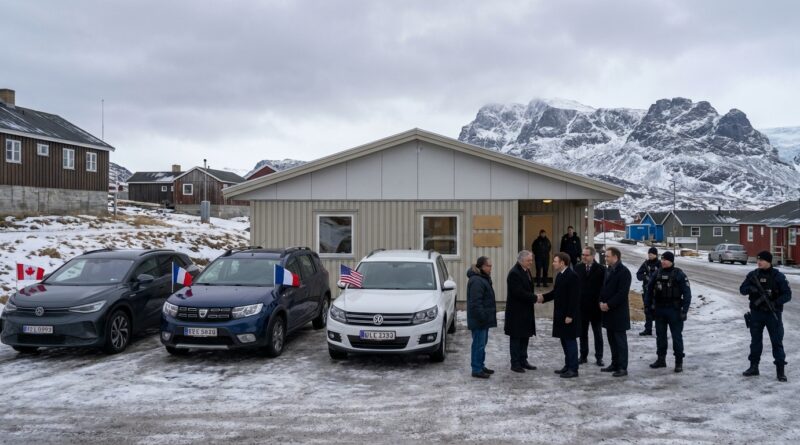
Canada and France Open Consulates in Greenland, Signaling Support for Denmark Amid Rising Geopolitical Tensions
Canada and France on Friday formally opened their diplomatic consulates in Nuuk, the capital of Greenland, a move widely seen as a show of solidarity with Denmark and the Arctic island at a time of growing geopolitical sensitivity in the region. The step comes against the backdrop of renewed interest by the United States in asserting control over Greenland, a semi-autonomous territory of Denmark and a strategic location in the Arctic.
Canada’s Foreign Minister Anita Anand officially inaugurated her country’s consulate in Nuuk. The ceremony featured the hoisting of Canada’s maple-leaf flag and the singing of the national anthem, “O Canada,” marking a symbolic moment in Canada–Greenland relations. Speaking at the event, Anand emphasized the broader significance of the move, stating that the opening of the consulate reflects Canada’s commitment to standing shoulder to shoulder with the people of Greenland and Denmark on a range of shared political, economic, and security issues.
France also marked its diplomatic entry into Greenland on the same day. According to the French Foreign Ministry, Jean-Noël Poirier assumed charge as France’s Consul General in Nuuk, making France the first European Union member state to establish a consulate general in Greenland. French officials said the decision was taken during President Emmanuel Macron’s visit in June, underscoring Paris’s intent to strengthen its presence and engagement in the Arctic region.
Canada had announced as early as 2024 its intention to open a consulate in Greenland—well before former US President Donald Trump’s recent remarks about “acquiring” the territory resurfaced. The inauguration, however, had been delayed due to adverse weather conditions.
The diplomatic developments follow heightened tensions after Trump last month announced plans to impose new tariffs on Denmark and seven other countries that opposed his stance on Greenland. Although the threat was later abruptly withdrawn, it added to concerns among NATO allies about stability and sovereignty in the Arctic.
By establishing a formal diplomatic presence in Nuuk, both Canada and France are signaling political support for Denmark and reinforcing their strategic interests in the Arctic—an increasingly important region amid climate change, emerging shipping routes, and global power competition.