
From Pleas for Aid to Power Projection: India’s Record Defence Budget Signals a Strategic Shift
Pakistan’s Prime Minister Shehbaz Sharif has, for the first time on a public platform, admitted a reality the world has observed for years: a country that seeks loans must bow its head. Acknowledging Pakistan’s repeated visits to so-called friendly nations for financial assistance, Sharif effectively put into words what had long been evident. For many, this statement stands out as a historic confession—one that future generations in Pakistan will look back on as proof of how the country’s military and political leadership pushed the nation into a position of dependence.
While poverty should never be mocked, the contrast is hard to ignore. At a time when Pakistan is lowering its head at foreign doors for economic survival, India has announced assistance for neighbouring countries in its national budget and simultaneously raised its defence allocation by a substantial 15 percent. After delivering a decisive blow to Pakistan last year during Operation Sindoor, the Indian government has now unveiled what many are calling a “powerhouse” defence budget.
The message is unambiguous: when it comes to national security, there is no room for compromise. No conditions, no hesitation. The logic is simple—only a secure nation can truly progress.
₹7.8 Lakh Crore for National Defence
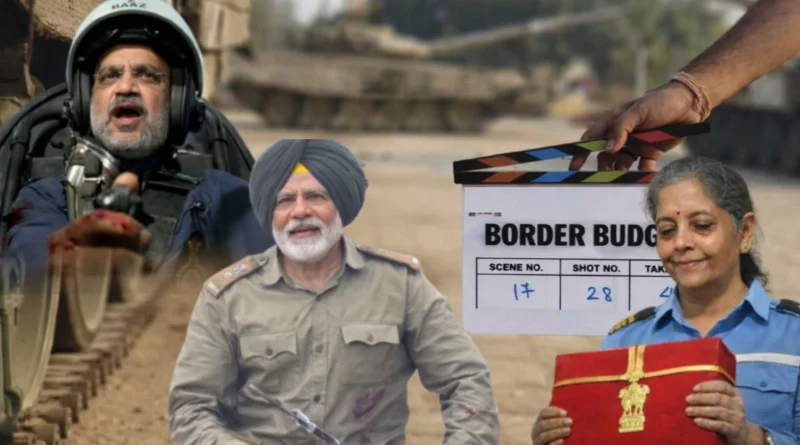
On 1 February, Finance Minister Nirmala Sitharaman presented the Union Budget for the financial year 2027, allocating a record ₹7.8 lakh crore to the Ministry of Defence. The government has consistently increased capital expenditure to support the acquisition of weapons, military equipment, and advanced technologies.
Under the capital outlay for modernisation, the armed forces will receive ₹2.19 lakh crore. Overall, the defence budget has risen by 15 percent, while capital outlay alone has seen a sharp increase of 21.84 percent—from ₹1.80 lakh crore in FY 2025–26 to ₹2.19 lakh crore. In simple terms, this means a clear push towards procuring new weapons and platforms: fighter jets, helicopters, missiles, radar systems, and other cutting-edge military technologies.
This unprecedented allocation is expected to fast-track the modernisation of the armed forces, replace outdated equipment, and significantly enhance India’s military strength. The budget is not merely about numbers—it is a roadmap for the future of India’s security.
Why This Budget Is Being Called a Game-Changer
Recent global conflicts—from Operation Sindoor to escalating tensions in West Asia and reports of advanced bombers being deployed—have reshaped the understanding of modern warfare. Wars today are no longer fought like Kargil or the 1971 conflict. The 21st century battlefield is defined by hypersonic missiles, drones, space-based assets, artificial intelligence, and cyber warfare.
Defence experts point out that countries like China possess large inventories of long-range and hypersonic missiles, advanced drone capabilities, space and AI warfare tools, and even information warfare through social media. India’s budget reflects a clear understanding of these evolving threats.
The sudden 15 percent jump in defence spending has caused visible discomfort in both Pakistan and China. For Pakistan, matching such an increase is simply impossible. But this budget is not just about Islamabad—it is about recognising global and regional realities.
Clear Focus on China
One of the key focus areas is Air Force modernisation. This includes new fighter jets, advanced avionics, and progress towards fifth-generation aircraft. India has already moved ahead with the induction and customisation of Rafale jets, tailored specifically to Indian operational requirements.
Investment is also being channelled into surveillance and ISR (Intelligence, Surveillance, Reconnaissance) systems, as well as high-altitude logistics. These preparations are particularly significant given the possibility of high-altitude conflict scenarios along the Line of Actual Control, including areas like Galwan. The emphasis makes it clear that while Pakistan remains a concern, China is the primary strategic focus.
Infrastructure development is another priority—roads, air bases, and permanent military stations at high altitudes, operational round the clock throughout the year. These steps underline India’s long-term preparedness for sustained operations in challenging terrain.
Preparing for Modern-Day Warfare
The growing use of drone strikes and precision attacks has also influenced budget priorities. Following Operation Sindoor, Prime Minister Narendra Modi stressed the need for a comprehensive security shield, particularly to protect civilians and major cities from drone and missile threats. Plans to safeguard urban centres were already announced; this budget now provides the financial backing to implement them.
The allocation also reflects preparation for a potential two-front scenario involving Pakistan and China. It focuses on deterrence through advanced capabilities—AI-enabled systems, cyber warfare tools, hypersonic missiles, and a fighter fleet capable of dominating airspace over extended periods.
Ultimately, the increased defence spending is driven not only by Pakistan but by China, shifting regional dynamics, and evolving security challenges. With growing ties among China, Pakistan, and Bangladesh, India is determined to ensure its armed forces remain fully equipped and battle-ready.
The government’s intent is clear: in any situation, India’s military must have the tools, technology, and readiness to respond decisively—and to win.