
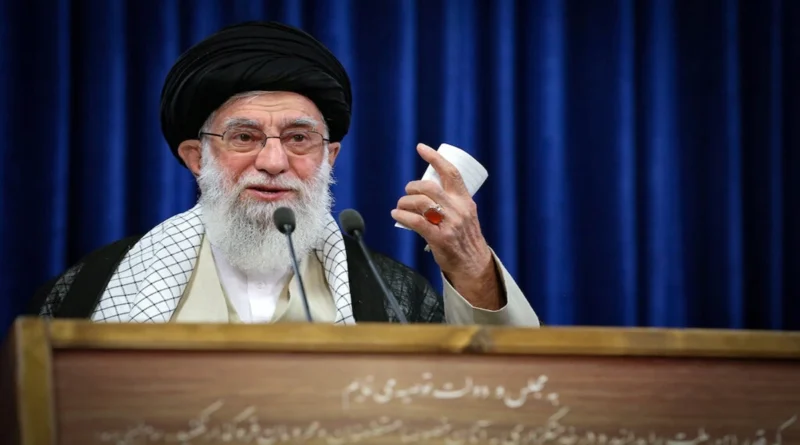
Khamenei Skips Historic Military Meeting for the First Time in 37 Years Amid Rising U.S.–Iran Tensions
For the first time in nearly four decades, Iran’s Supreme Leader Ayatollah Ali Khamenei did not attend the annual meeting with army and air force commanders on Sunday—an absence that has drawn significant attention both inside and outside the country. Since assuming the role of Supreme Leader in 1989, Khamenei has participated in this event every single year, without interruption, even during the height of the COVID-19 pandemic.
In his place, the Chief of Staff of Iran’s Armed Forces, Major General Abdolrahim Mousavi, met with the army and air force commanders. While Mousavi’s presence ensured the meeting went ahead, Khamenei’s absence marked a notable break from a long-standing and deeply symbolic tradition.
The annual gathering is held to commemorate February 8, 1979—a pivotal moment during the Iranian Revolution—when a group of Iranian Air Force officers pledged allegiance to Ayatollah Ruhollah Khomeini, the founder of the Islamic Republic and Khamenei’s predecessor. Over the past four decades, this date has evolved into a powerful symbol of unity between Iran’s military leadership, particularly the air force, and the country’s religious establishment. Every year, air force personnel and senior commanders traditionally meet the Supreme Leader on this occasion as a reaffirmation of loyalty and continuity.
This year, however, that symbolism was altered. Reports indicate that instead of Khamenei, Abdolrahim Mousavi addressed and met the commanders, underscoring the unusual nature of the Supreme Leader’s absence.
The timing of Khamenei’s nonappearance has fueled speculation, as it coincides with escalating tensions between Tehran and Washington. The United States has increased its military presence in the region, and fears of a potential American military strike against Iran have intensified. Observers interpret Khamenei’s absence as either a precautionary measure to avoid potential threats or a sign that he is deeply engaged in critical national security matters behind the scenes.
Iranian leadership is reportedly haunted by the prospect of an attack similar to the events of June 2025. On June 19, 2025, then-U.S. President Donald Trump told reporters that a decision on striking Iran would be made within two weeks. Yet just two days later, on June 21, Operation Midnight Hammer was launched under his orders. During the operation, the U.S. Air Force and Navy carried out strikes on three major Iranian nuclear facilities—Fordow, Natanz, and Isfahan—dramatically escalating hostilities.
According to reports, heightened security concerns have led Khamenei to deliberately distance himself from large public events during this volatile period. Some sources even claim that, despite U.S. envoys publicly dismissing the likelihood of further escalation, the Supreme Leader has relocated to a heavily fortified underground bunker in Tehran as a precautionary step.
Together, these developments paint a picture of an increasingly tense regional environment, where even long-standing traditions are being set aside in the face of perceived existential threats.