
PM Modi’s Malaysia Visit Signals India’s Confident Outreach to Southeast Asia
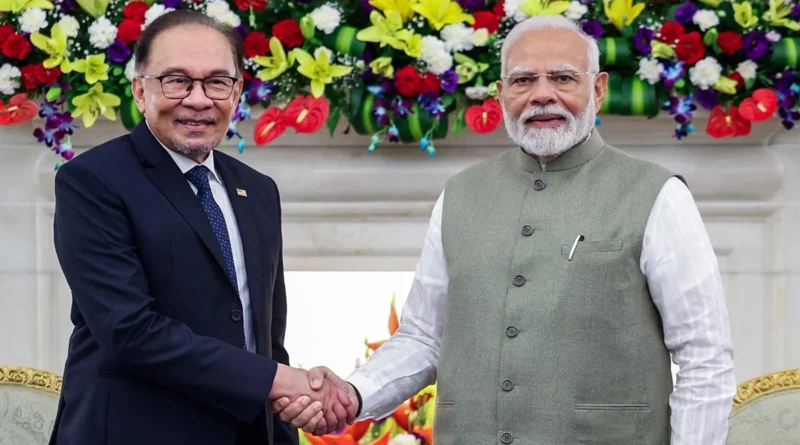
Prime Minister Narendra Modi will be on an official visit to Malaysia on 7 and 8 February, at the invitation of Malaysian Prime Minister Anwar Ibrahim. The visit carries added significance on several fronts. It will be Modi’s third trip to Malaysia and his first since India and Malaysia elevated their ties to a Comprehensive Strategic Partnership in August 2024. At a time when global power equations are shifting, the visit underlines India’s proactive and self-assured foreign policy approach.
In Kuala Lumpur, the two leaders will hold wide-ranging talks covering trade and investment, defence and security, maritime cooperation, digital and financial technologies, energy, healthcare, education, culture, tourism, and people-to-people exchanges. Alongside these discussions, the 10th India–Malaysia CEO Forum will also be held, an event expected to inject fresh momentum into economic cooperation between the two countries.
India–Malaysia relations are deeply rooted in shared history, civilisation, and cultural links. Malaysia is home to nearly 2.9 million people of Indian origin, one of the largest Indian diaspora communities in the world. This community serves as a vital bridge between the two nations. During his visit, Prime Minister Modi will address the Indian diaspora, with nearly 15,000 people expected to gather at a large venue in Kuala Lumpur. More than 60 community organisations are jointly organising the welcome event, showcasing both India’s diversity and its natural integration within Malaysian society.
The timing of the visit also coincides with a festive period in Malaysia, marked by celebrations such as Thaipusam, the Chinese New Year, and traditional dragon dances. Modi’s presence during these cultural festivities is expected to highlight India’s soft power and reinforce its image as a society that embraces diversity and pluralism.
It is worth recalling that Prime Minister Modi was unable to attend the ASEAN Summit in Malaysia last October due to domestic commitments, with External Affairs Minister S. Jaishankar representing India instead. This visit helps bridge that gap. In the interim, Jaishankar and his Malaysian counterpart have already engaged in discussions on bilateral cooperation and regional issues, including the situation in Myanmar.
Malaysia is currently India’s third-largest trading partner within ASEAN, making the relationship strategically important. Southeast Asia occupies a central place in India’s Look East and Act East policies, and this visit further strengthens that engagement. India is also holding the BRICS presidency this year and will host the upcoming BRICS summit, making sustained outreach to Southeast Asia even more relevant.
In a recent virtual address at the ASEAN–India Summit, Prime Minister Modi described the 21st century as the century of India and ASEAN, reaffirming India’s commitment to ASEAN unity, its central role, and the Indo-Pacific vision. He also pledged to accelerate the review of the free trade agreement, strengthen regional stability, promote collective action against terrorism, and support the 2026–2030 Plan of Action. India also welcomed Timor-Leste as ASEAN’s newest member, reinforcing its support for regional inclusiveness.
The visit also fits into a broader diplomatic pattern. In recent months, leaders from several Islamic countries have visited India, and foreign ministers from the Gulf region were in New Delhi just last week. Modi’s Malaysia visit underscores that India’s diplomatic engagement is not confined to the West. Instead, New Delhi is building balanced, respectful relationships from West Asia to Southeast Asia.
The growing ease in India’s relations with Muslim-majority nations has not come by chance. It is the result of sustained dialogue, mutual respect, and a clear focus on shared interests. From the Gulf to Southeast Asia, India has consistently demonstrated that it speaks the language of cooperation, not religion. The Malaysia visit is a continuation of this approach.
Malaysia’s importance for India goes beyond trade. Its strategic location along key maritime routes, its role in Indo-Pacific dynamics, and its influence within ASEAN make it a crucial partner. The large Indian-origin community in Malaysia acts as a living ambassador of India’s values and culture. When India’s Prime Minister visits, he does more than sign agreements—he builds trust and goodwill.
Ultimately, the message of the Malaysia visit is clear: India seeks friendship anchored in national interest, partnerships built on equality and respect, and a global role as an active, confident stakeholder. That is the deeper strategic meaning of Prime Minister Modi’s visit to Malaysia.