
A Disturbing Pattern: Targeted Killings of Hindus Deepen Minority Fears in Bangladesh
The wave of killings of Hindu men reported across Bangladesh in December 2025 has raised profound concerns about minority safety in the country. Far from appearing as isolated criminal acts, these deaths — at least 12 within a single month — are increasingly being viewed by observers and community members as part of a longer trajectory of vulnerability faced by the Hindu minority.
Many of the fatalities reportedly stemmed from mob violence and forms of extrajudicial punishment. Together, they underscore a troubling reality: when political volatility converges with religious radicalization, minority communities often find themselves dangerously exposed.
A Grim Roll Call
Among those who lost their lives were Dipu Chandra Das, Amrit Mondal (also known as Samrat), Dilip Barman, Prantosh Karmakar, Utpal Sarkar, Jogesh Chandra Roy, Suvarna Roy, Shanto Das, Ripon Kumar Sarkar, Pratap Chandra, Swadhin Chandra, and Palash Chandra.
Authorities have treated each case as a separate criminal matter. Yet when viewed collectively, the incidents appear less coincidental and more reflective of a recurring pattern — one that signals systemic insecurity rather than random tragedy.
Radical Narratives and Anti-India Sentiment
The broader social climate has also come under scrutiny. Critics argue that a steady rise in hardline rhetoric and ideological polarization has created an atmosphere in which hostility toward Hindus is increasingly normalized.
Anti-India discourse, amplified in certain political and social circles, is said to have further complicated the situation. In some cases, antagonism toward Hindus is framed not as extremism but as ideological resistance. Language associated with reform movements or student activism has, according to analysts, occasionally been used as cover for advancing sectarian agendas.
Such dynamics not only strain Bangladesh’s internal social fabric but also position the country in a contentious regional narrative involving India — a nation whose rising global profile has drawn both admiration and opposition. The consequences of this ideological polarization are often borne domestically, particularly by minorities with perceived cross-border religious or cultural ties.
Blasphemy Allegations as a Trigger
Several of December’s killings reportedly followed accusations of blasphemy — a charge that has emerged as a potent and volatile weapon. These allegations frequently surface without formal complaints, transparent investigations, or substantiated evidence. Yet they can swiftly inflame public anger and mobilize crowds.
In other instances, victims were accused of criminal behavior or extortion. Regardless of the allegation, the outcome was often the same: mob “justice” replacing legal due process.
One widely discussed case involved Dipu Chandra Das, a Hindu textile worker in Mymensingh district. During a workplace gathering, he was accused of making derogatory remarks about Islam. A crowd allegedly attacked him, tied him to a tree, hanged him, and set his body ablaze. Subsequent investigative findings reportedly found no direct proof of blasphemy — highlighting how unverified claims can spiral into lethal violence when state safeguards falter.
Similarly, in Rajbari district, Amrit Mondal was beaten to death. Officials later emphasized his alleged criminal background while dismissing communal motivations. Yet for many within the Hindu community, the manner of his death — at the hands of a mob rather than through arrest and trial — reinforced longstanding anxieties about unequal access to due process.
Institutional Strain and Political Turbulence
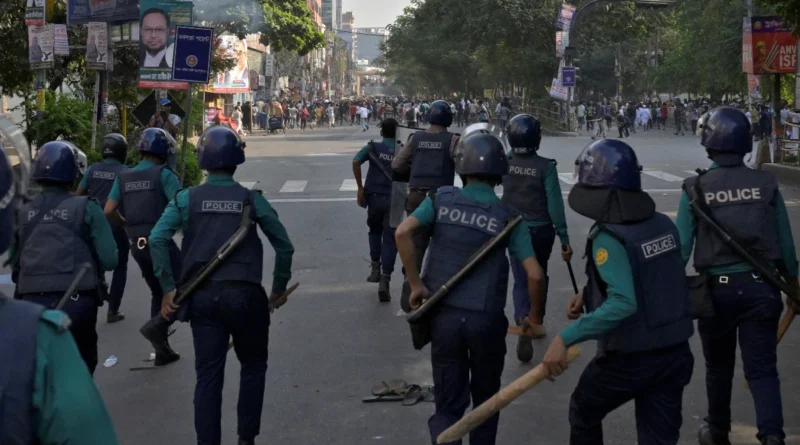
These killings unfolded against the backdrop of widespread protests and political instability, conditions that have stretched law enforcement and administrative systems in several districts. During periods of upheaval, minority communities often become more visible targets — either through organized hostility or because they are perceived as lacking political protection.
Religion has increasingly emerged as a powerful political mobilizer. Hardline Islamic groups and their affiliates, including certain student organizations, have reportedly leaned on religious nationalism to consolidate support ahead of elections. In the absence of detailed governance agendas, identity-based mobilization can become a potent — and divisive — tool.
The interim administration led by Muhammad Yunus has condemned the killings and reiterated opposition to mob justice. Arrests have followed some incidents. However, for many minority families, post-incident condemnations offer limited reassurance. Security, they argue, is measured not by statements after tragedy but by prevention, swift intervention, and sustained accountability — areas where confidence remains fragile.
A Cycle That Repeats
For Bangladesh’s Hindu minority, the pattern feels painfully familiar: accusations surface, crowds assemble, violence erupts, and official assurances follow. Yet the underlying vulnerabilities appear unchanged.
Observers warn that unless religious and criminal allegations are addressed strictly through lawful mechanisms — and unless minority protection is upheld irrespective of political calculations — the cycle is likely to persist.
The events of December 2025, therefore, are not merely a sequence of individual crimes. They represent a convergence of political unrest, radical mobilization, and identity-based hostility — a combination that leaves minority communities standing on precarious ground.