
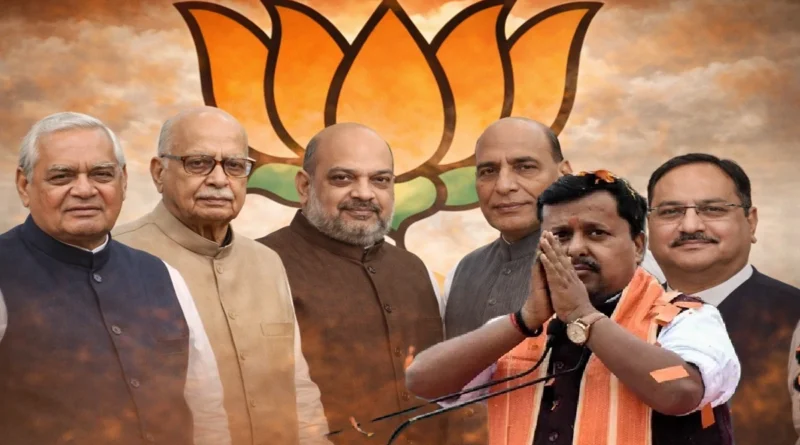
BJP Names Nitin Nabin as Its Youngest National President: A Look at the Party’s Leadership Journey
The Bharatiya Janata Party (BJP) on Tuesday announced Nitin Nabin as its new National President at a ceremony held at the party headquarters in New Delhi. The event was attended by Prime Minister Narendra Modi, Union Home Minister Amit Shah, Defence Minister Rajnath Singh, and several senior party leaders.
At 45, Nitin Nabin has become the 12th National President of the BJP and the youngest person to ever hold this position. He was elected unopposed. Earlier, on December 15, he had taken charge as the party’s National Working President. The formal election process for the BJP president began after elections were completed for 30 out of 36 state unit presidents, crossing the mandatory 50 percent threshold. The election schedule and voter list were released on January 16, 2026. Nomination papers were filed on Monday between 2 pm and 4 pm, with Nitin Nabin receiving 37 nominations. Prime Minister Modi, Amit Shah, Rajnath Singh, and other senior leaders proposed his name.
Since its formation in 1980, the BJP has been led by several influential presidents who have shaped the party’s ideology, organisational strength, and electoral strategy in different ways. From its early years under Atal Bihari Vajpayee to the present leadership under Nitin Nabin, the evolution of BJP presidents reflects the party’s transformation from a small political force into the world’s largest political party in terms of membership.
Key BJP Presidents Over the Years
Lal Krishna Advani (1986–1991)
Known for his hardline image, Lal Krishna Advani took over as BJP president during a crucial phase. Under his leadership, with ideological guidance from the RSS, the party firmly adopted the Hindutva path, which went on to define its political direction in the years that followed.
Murli Manohar Joshi (1991–1993)
The BJP contested the 1991 general elections with the Ram Temple issue at its core and won 120 seats, emerging as the second-largest party in the country. This period reinforced the party’s belief in nationalism rooted in cultural identity. During Joshi’s tenure, the famous Tiranga Yatra was undertaken with the aim of hoisting the national flag at Lal Chowk in Srinagar on January 26, 1992.
Lal Krishna Advani (1993–1998)
With Hindutva and the Ram movement gaining momentum, the BJP rose rapidly. From just two seats in 1984, it became the second-largest party within seven years. Advani returned as president in 1993 and recognised the need for a more moderate face to take the party to power. In 1995, he declared Atal Bihari Vajpayee as the prime ministerial candidate, a move that surprised many but proved decisive.
Kushabhau Thakre (1998–2000)
Following the formation of a BJP-led government under Vajpayee, Kushabhau Thakre—often referred to as the party’s patriarch—was appointed president. He is widely credited with strengthening the BJP’s organisational base, particularly in Madhya Pradesh.
Bangaru Laxman (2000–2001)
Hailing from Andhra Pradesh, Bangaru Laxman became BJP president in 2000. However, his tenure was cut short after he was embroiled in the Tehelka sting operation, which not only cost him his position but also raised questions about the party’s image.
Jana Krishnamurthy (2001–2002)
After Laxman’s exit, Jana Krishnamurthy served as BJP president for a brief period, ensuring organisational continuity during a transitional phase.
Venkaiah Naidu (2002–2004)
Current Vice President of India, Venkaiah Naidu was appointed BJP president in 2002. He had earlier served as the head of the Janata Party’s youth wing between 1977 and 1980.
Lal Krishna Advani (2004–2006)
After the “India Shining” campaign failed in the 2004 elections, Advani once again took charge of the party. However, under his leadership, the BJP also faced defeat in the 2009 general elections.
In the years that followed, the BJP saw several presidents, including Rajnath Singh and Nitin Gadkari. A major turning point came with Narendra Modi’s rise, whose leadership and image helped the party secure a full majority at the Centre.
JP Nadda
The election for the BJP National President was held on January 20, following which JP Nadda was formally appointed as the full-time president for a three-year term. He had earlier been named Working President on June 17, 2019.
Who Is Nitin Nabin?
Nitin Nabin is a senior BJP leader from Bihar with a strong grassroots connect and deep organisational experience. Born in Patna, he is the son of the late Nabin Kishore Prasad Sinha, a respected BJP leader and former विधायक. After his father’s untimely demise, Nitin Nabin stepped into active politics and gradually carved out his own identity.
Representing the Bankipur Assembly constituency in Patna, he is regarded as one of the most reliable BJP leaders in Bihar. Since winning a by-election in 2006, he has gone on to secure victories in the 2010, 2015, 2020, and 2025 Assembly elections. In the most recent Bihar elections, he registered a decisive win from Bankipur, defeating his closest rival by a margin of over 51,000 votes. This consistent electoral success has significantly strengthened his standing within the party.
Currently, Nitin Nabin serves as the Minister for Road Construction and Urban Development in the NDA government led by Chief Minister Nitish Kumar in Bihar. He is widely credited with effectively managing the BJP–JDU alliance and playing a key role in the NDA’s electoral success. Beyond Bihar, he has also served as the BJP’s in-charge for Chhattisgarh, highlighting his growing influence within the party’s national framework.