
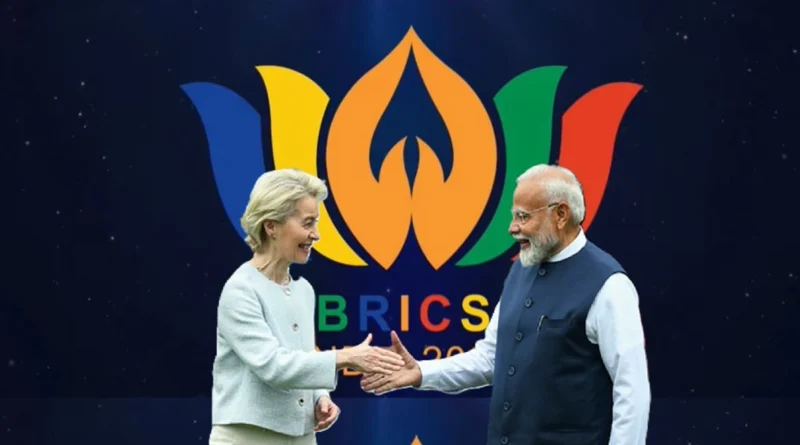
BRICS 2026: India Steps Forward as a Steady Global Leader in an Unsettled World
As the world grapples with fear and uncertainty driven by Donald Trump’s unpredictable policies, tariff wars, and growing geopolitical chaos, India is quietly but confidently laying the groundwork for an alternative model of global leadership. The stage for this emerging role will be the BRICS Summit 2026, which India is set to host.
If 2025 marked a cooling phase in India–US relations, 2026 is expected to be even more challenging and complex. The reason is clear: Donald Trump increasingly positions himself above the established global order. Pressure on Venezuela’s resources, renewed threats of sanctions on Cuba, tariffs on Mexico, and warnings of a 25% tax on those trading with Iran are collectively pushing the world toward instability and uncertainty. Such turbulence is bound to directly impact emerging powers like India.
For India, BRICS 2026 represents a decisive turning point. External Affairs Minister S. Jaishankar, Prime Minister Narendra Modi, and India’s diplomatic establishment have the opportunity to shape not just India’s future, but that of the entire Global South through this summit.
India has recently and officially assumed the BRICS presidency for 2026. At a ceremony in New Delhi, External Affairs Minister Dr. S. Jaishankar unveiled the summit’s logo, theme, and official website. Ambassadors from key BRICS nations such as Brazil, China, and Russia, along with representatives from several other countries, were present at the event.
In his address, Jaishankar emphasized the significance of the theme and logo under India’s leadership. He stated that India aims to make BRICS more inclusive and human-centric during its presidency. He also noted that India’s leadership comes at a symbolic moment, as BRICS completes 20 years. Over this journey, the grouping has evolved into a vital platform for cooperation among emerging economies and markets.
The global environment today is fraught with challenges—geopolitical uncertainty, a complex economic landscape, and escalating climate concerns. BRICS is no longer a marginal grouping. With 11 member nations, it represents nearly 50% of the world’s population, 40% of global GDP, and 26% of global trade.
A recent report by the European Parliament has clearly stated that the time has come to strengthen engagement with BRICS Plus countries. Against this backdrop, BRICS 2026 is not merely another international summit for India—it is a test of leadership. It is a moment of hope for the Global South and an opportunity to offer the world a more balanced and inclusive global pathway.
If India succeeds, Vasudhaiva Kutumbakam will no longer remain just a philosophical slogan—it could well evolve into a guiding principle of global policy.