
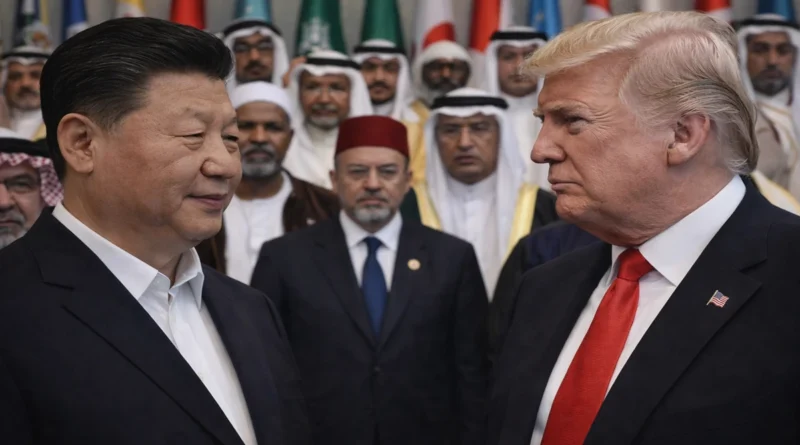
China Deepens Outreach to Islamic World, Warns Against “Might Makes Right” Global Order
China’s Foreign Minister Wang Yi met with the Secretary-General of the Organization of Islamic Cooperation (OIC), Hissein Brahim Taha, in Beijing, underscoring Beijing’s growing engagement with the Islamic world amid rising global tensions. During the meeting, Wang described the OIC as the largest and most influential collective body representing Muslim-majority nations, and reiterated that China places consistent importance on its relations with both the organization and its member states.
Wang expressed appreciation for the OIC and Islamic countries for backing China’s positions on sensitive issues such as Xinjiang and Taiwan. He emphasized that China seeks closer coordination with Islamic nations to safeguard the rights and interests of developing countries, particularly at a time when global power dynamics are becoming increasingly unstable.
A central theme of Wang’s remarks was his strong opposition to what he termed the return of the “law of the jungle” in international affairs. He argued that global governance should be based on fairness, dialogue, and mutual respect rather than coercion and unilateral pressure. Wang urged China and the OIC to jointly resist any drift toward power-based politics and economic intimidation.
Looking ahead, he called for deeper cooperation on high-quality Belt and Road Initiative projects, greater coordination on political solutions to conflicts in troubled regions, and collective efforts to preserve peace and stability in the Middle East. According to Wang, constructive development partnerships and diplomacy—not confrontation—are essential for long-term regional and global security.
Without naming individuals directly in diplomatic language, Wang attributed the growing sense of disorder in global affairs to policies associated with former U.S. President Donald Trump. He warned that arbitrary tariffs, sweeping sanctions, and restrictions on trade between countries were pushing the world toward an unstable system where rules are replaced by raw power. Such actions, he said, undermine global cooperation and disproportionately harm developing nations.
The meeting took place against the backdrop of escalating tensions in the Middle East. Around the same time, U.S. President Donald Trump announced that, as a precautionary measure, a large U.S. naval force was being deployed to the region. He also issued warnings to Iran, urging it not to crack down on protesters or restart its nuclear program.
Adding to the gravity of the situation, an Iranian official claimed that at least 5,000 people had been killed during protests driven by economic hardship—figures that highlight the scale of internal unrest. U.S. officials separately confirmed that an aircraft carrier and multiple missile destroyers were expected to arrive in the Middle East shortly.
In this tense geopolitical environment, Wang Yi reiterated China’s call for regional security partnerships and political dialogue as the only viable path to resolving crises. His engagement with the OIC signals Beijing’s intent to position itself as a stabilizing force and a leading voice for the developing world at a time when global power rivalries are intensifying.