
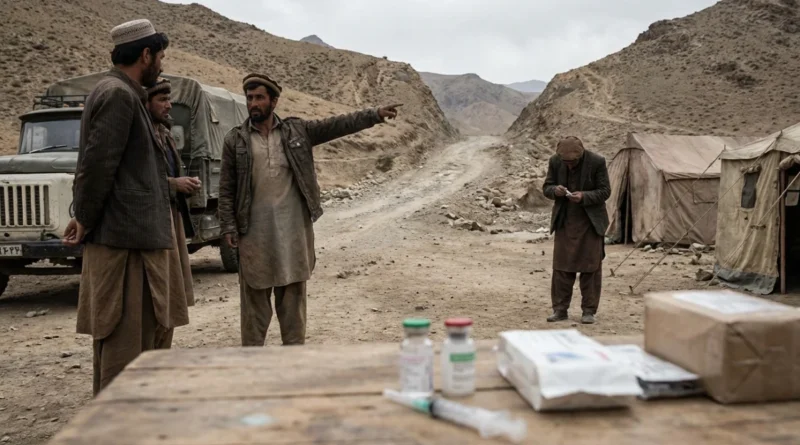
From Dependence to Diversification: How Indian Medicines Are Reshaping Afghanistan’s Healthcare Landscape
South Asia’s geopolitical equations are changing rapidly, and one of the clearest signs of this shift is emerging from Afghanistan’s pharmaceutical market. A country that once depended heavily on Pakistan for even its most basic medical needs is now decisively moving away from that reliance. Recent developments on the ground indicate that Pakistani products—especially medicines—are steadily losing their dominance in Afghanistan, making way for a growing presence of Indian pharmaceuticals.
Walk into medical stores and hospital pharmacies across Kabul today, and a new story is unfolding on the shelves. This quiet but significant transformation in Afghanistan’s healthcare sector recently came into public focus through a social media post by an Afghan blogger, highlighting how Indian medicines are becoming the preferred choice for both pharmacists and patients.
A Headache Pill That Revealed a Bigger Shift
On social media platform X (formerly Twitter), a blogger named Fazal Afghan shared a personal experience that quickly drew attention. He recounted visiting a pharmacy in Kabul to buy “Parol,” a popular paracetamol brand commonly sold in Pakistan and Turkey. Trusting the Turkish brand for its perceived quality, he specifically asked for it. Instead, the shopkeeper suggested that he try an Indian alternative.
The price comparison was striking:
- A strip of 10 Turkish-made paracetamol tablets cost 40 Afghanis.
- The Indian-made equivalent, with the same salt composition and dosage, was priced at just 10 Afghanis.
According to Fazal, the pharmacist explained that Indian medicines were not only far more affordable but also delivered faster and better results compared to other available options. Intrigued by the price difference, Fazal chose the Indian tablets—and found that his headache subsided quickly.
Reflecting on the experience, he wrote that Indian medicines are gradually replacing Pakistani drugs across Afghanistan. What seemed like a routine purchase of painkillers, in reality, pointed to a much larger structural shift underway in the Afghan pharmaceutical supply chain.
Declining Pakistani Presence After Political and Border Tensions
Pakistan’s share in Afghanistan’s pharmaceutical market has been shrinking following a series of border clashes and political tensions between the two countries. While Pakistan’s market share had already been declining since 2024, the situation changed dramatically after fresh clashes in October–November 2025.
In response, Afghanistan’s Deputy Prime Minister Abdul Ghani Baradar imposed an immediate ban on Pakistani medicines, citing poor quality concerns. Afghan traders were urged to seek alternative suppliers from India, Iran, and Central Asia.
Around the same time, Indian pharmaceutical exports to Afghanistan surged. In the financial year 2024–25 alone, India exported medicines worth $108 million to Kabul. Reports suggest that an additional $100 million worth of exports followed during the remainder of 2025, underlining India’s rapidly expanding footprint.
Why Afghanistan Turned Away from Pakistani Pharmaceuticals
As a landlocked country with a fragile domestic healthcare industry, Afghanistan has historically depended on imports for medicines—often relying almost entirely on Pakistan. Geographic proximity and low-cost overland routes through Torkham and Chaman made Pakistani supplies the most accessible option.
Domestic pharmaceutical production in Afghanistan remains extremely limited. The country imports between 85% and 96% of its medicines. According to UN COMTRADE data accessed via Trading Economics, Pakistan exported medicines worth $186.69 million to Afghanistan in 2024. Earlier estimates put Pakistan’s 2023 exports at around $112.8 million.
Taliban officials have stated that, until November 2025, more than 70% of medicines used in Afghanistan came from Pakistan. This deep dependence was further reinforced after 2001, when decades of war devastated Afghanistan’s infrastructure and left it without adequate quality control systems or laboratories—making Pakistani imports the most practical and economical choice.
However, repeated border closures and escalating tensions changed the equation. Last year, the closure of Torkham and Chaman crossings severely disrupted trade. Following this, the Taliban administration imposed a complete ban on Pakistani pharmaceuticals.
The immediate impact was severe. Reports, including one by Deutsche Welle (DW), highlighted acute shortages of antibiotics, insulin, and cardiac medicines. In some cases, pharmacists either charged exorbitant prices or resorted to selling counterfeit drugs.
India Steps In During Afghanistan’s Medical Crisis
As shortages began to bite in November 2025, India moved quickly to support Afghanistan. External Affairs Minister S. Jaishankar announced the dispatch of an emergency consignment of 73 tonnes of life-saving medical supplies to Kabul.
This assistance was not unprecedented. In April the previous year, India had sent 4.8 tonnes of vaccines for diseases such as rabies and hepatitis B, along with six ambulances equipped with life-saving devices and an advanced 128-slice CT scanner. Earlier, in 2022, following a devastating earthquake in Afghanistan, India supplied 13 tonnes of medical aid, including 500,000 COVID-19 vaccine doses.
Over the past four years, India has provided a total of 327 tonnes of medical supplies. Beyond emergency aid, New Delhi has committed to building five maternity and healthcare clinics in the provinces of Paktia, Khost, and Paktika, as well as a 30-bed hospital in Kabul.
India has also pledged to support the construction and upgrading of major facilities in Kabul, including oncology, trauma, diagnostic, and thalassemia centers. Requests from Afghanistan for radiotherapy machines and additional medical equipment are also under consideration.
These initiatives followed a meeting in December 2025 between India’s Health Minister J. P. Nadda and Afghanistan’s Public Health Minister Maulvi Noor Jalal Jalali.
India is also planning to send a team of senior doctors to Afghanistan to set up medical camps and train Afghan healthcare professionals. This builds on the success of a medical camp held in June last year, where 75 Afghan patients received prosthetic limbs.
All these efforts complement the long-standing Indira Gandhi Children’s Hospital in Kabul—a 400-bed facility established in 1969 with Indian funding, which also houses Afghanistan’s first cerebral palsy center.
How Indian Pharma Companies Are Filling the Vacuum
According to Afghanistan’s daily newspaper Hasht-e-Subh, India currently exports nearly $100 million worth of medicines to Afghanistan, accounting for 12–15% of the country’s pharmaceutical market. Pakistan, which once held a 35–40% share, has seen its presence nearly disappear.
Industry estimates suggest that India could potentially export $200 million or more in medicines annually, as Pakistani pharmaceutical sales have almost collapsed.
Indian companies are not limiting themselves to exports alone. In November 2025, a landmark agreement was signed when Zydus Lifesciences entered into a $100 million Memorandum of Understanding with Afghanistan’s Rofi International Group in Dubai. While the initial focus will be on exports, the agreement envisions technology transfer, the establishment of a Zydus representative office in Afghanistan, and eventually local manufacturing facilities to reduce import dependence.
Taliban officials are also in discussions with another Indian firm, Pharmexcil, regarding joint investments in production units, laboratories, and pharmaceutical infrastructure.
A Small Choice, A Major Signal
The Afghan blogger’s decision to choose an affordable Indian painkiller over a familiar Turkish or Pakistani brand may seem minor at first glance. But it reflects a profound shift in Afghanistan’s medical supply ecosystem—one driven by geopolitics, economics, quality concerns, and timely humanitarian support.
As Indian pharmaceuticals steadily replace Pakistani products on Afghan shelves, the transformation signals not just a change in trade flows, but a broader realignment in regional influence—one pill, one pharmacy, and one patient at a time.