
India–EU Strategic Leap: Trade, Defense, and Technology Partnerships Enter a New Era
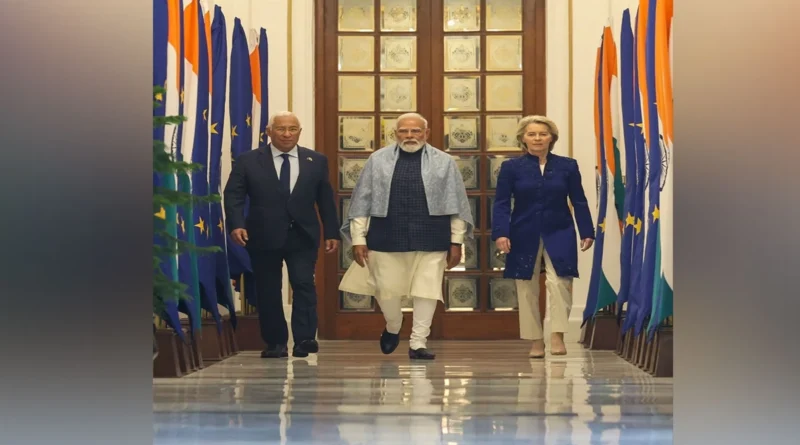
During the state visit of European Council President António Costa and European Commission President Ursula von der Leyen, India and the European Union marked a major milestone in their relationship by signing 13 agreements and frameworks spanning trade, security, defense, mobility, clean energy, science, and disaster management. These agreements were finalized on Tuesday at the 16th India–EU Summit, co-chaired by Prime Minister Narendra Modi.
According to the official outcomes released by India’s Ministry of External Affairs, the leaders welcomed the adoption of “Towards 2030: A Joint India–European Union Comprehensive Strategic Agenda.” This document serves as an overarching roadmap to guide the India–EU strategic partnership over the coming decade, signaling a clear intent to move beyond limited cooperation toward a deeper, more structured alliance.
A central highlight of the visit was the conclusion of negotiations on the India–EU Free Trade Agreement (FTA), widely described as the largest trade deal in India’s history. The agreement is designed to significantly strengthen economic ties, boost investments, and create new opportunities for businesses and workers on both sides.
Prime Minister Modi, welcoming the finalization of the FTA, emphasized that it should not be seen merely as a trade pact but as a blueprint for shared prosperity. Speaking at a joint press conference with European leaders, he noted that India–EU relations have expanded rapidly in recent years, driven by common democratic values, economic complementarity, and strong people-to-people connections. He also acknowledged that bilateral trade between India and the EU has already reached approximately €180 billion, underlining the scale and importance of the partnership.
In the domain of defense and security, a significant breakthrough came with the formalization of the India–EU Security and Defence Partnership (SDP). This first-of-its-kind framework establishes structured cooperation in maritime security, defense industry and technology, cyber and hybrid threats, space cooperation, and counterterrorism. To further deepen defense ties and enable the secure exchange of classified information, discussions were also initiated on an India–EU Information Security Agreement.
With this step, India became only the third Asian country—after Japan and South Korea—to enter into such an arrangement with the European Union, highlighting the high level of strategic trust between the two sides.
Financial and technological cooperation was also strengthened through a memorandum of understanding between the Reserve Bank of India and the European Securities and Markets Authority. In addition, an administrative arrangement on advanced electronic signatures and digital seals was agreed upon, facilitating smoother cross-border digital and financial transactions.
Mobility and talent exchange featured prominently in the discussions. Both sides agreed on mobility frameworks, including the establishment of a pilot EU Legal Gateway Office in India aimed at promoting skill mobility and legal cooperation. Disaster management cooperation was reinforced through an agreement between India’s National Disaster Management Authority (NDMA) and the EU’s Directorate-General for Civil Protection and Humanitarian Aid Operations, enhancing joint preparedness and response capabilities.
In the areas of science, technology, and clean energy, the partnership took another step forward with the renewal of the India–EU Science and Technology Cooperation Agreement for the 2025–2030 period. The two sides also agreed to set up a Green Hydrogen Task Force and launched preliminary discussions on India’s association with the EU’s flagship research program, Horizon Europe.
Beyond bilateral initiatives, India and the EU committed to jointly implementing four trilateral projects. These initiatives will focus on digital innovation for women and youth, solar-powered solutions for farmers, early warning systems, and sustainable energy transitions in regions such as Africa, the Indo-Pacific, the Caribbean, and small island developing states.
Taken together, these agreements reflect a decisive shift in India–EU relations—from selective cooperation to a comprehensive, future-oriented strategic partnership with global reach and long-term ambition.