
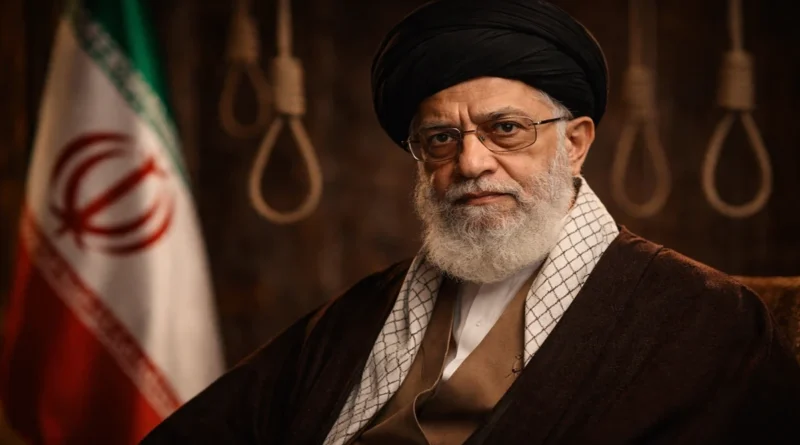
Khamenei’s Fear Strategy Begins: Executions as a Warning—or the Final Trigger?
Iran’s Supreme Leader appears to have chosen the harshest possible response to the rising voice of rebellion. Those who dared to challenge the system are now being sent to the gallows. January 14 marks the first execution amid this new wave of unrest—a move widely seen as a last-ditch attempt to terrify Iran’s revolutionary masses into silence.
But the real question is this:
Will this execution suppress the uprising—or become the spark that finally topples the regime?
The hardline security apparatus arrested Irfan Sultani on January 8. Within just three days, charges were framed, the trial rushed through, and his execution scheduled. By January 11, the death sentence was pronounced. What stands out is not just the punishment—but the speed, secrecy, and denial of basic legal rights.
Sultani is being executed under Iran’s notorious “Moharebeh” (enmity against God) law. His family was never informed which agency detained him. Reports claim he was denied legal counsel, not allowed to defend himself, and given no meaningful opportunity to speak during proceedings.
A Trial in Name Only
After sentencing, Sultani was allowed to meet his family for just ten minutes. They were bluntly told the verdict was final and the execution would proceed as scheduled.
What makes the case even more disturbing is that his sister is a licensed lawyer, yet she was neither allowed to review the case files nor permitted to represent her brother.
There are growing claims that the regime may go a step further—to make an example of him. Sources suggest Sultani could be publicly hanged at a city square, a punishment that Iranian law still allows. The intent is clear: to instill fear, to send a message to protesters watching closely.
Khamenei’s calculation seems straightforward—terror will break the spirit of resistance.
But history suggests the opposite.
A Decision That Could Backfire
The speed and brutality of the punishment have already fueled public anger. Many believe that instead of frightening the masses, this execution may ignite a new phase of rebellion. In Iran’s past, such acts of repression have often accelerated revolutions rather than stopped them.
And Iran has seen this story before.
When Executions Failed to Save a Regime
In the late 1970s, Iran was ruled by Shah Mohammad Reza Pahlavi, whose authoritarian grip had reached its peak. In 1978, desperate to crush dissent, the Shah gave security forces free rein.
On September 8, 1978, troops opened fire on hundreds of protesters at Tehran’s Jaleh Square. The day went down in history as Black Friday.
Instead of restoring order, the massacre enraged the nation.
Just 156 days later, on February 11, 1979, the Shah was overthrown.
A Familiar Pattern, A Dangerous Gamble
Executions meant to silence dissent have repeatedly done the opposite—turning fear into fury. As Iran once again stands at a crossroads, many believe that hanging Irfan Sultani may not save the regime, but hasten its downfall.
History has shown time and again:
You can execute people—but not an idea.