
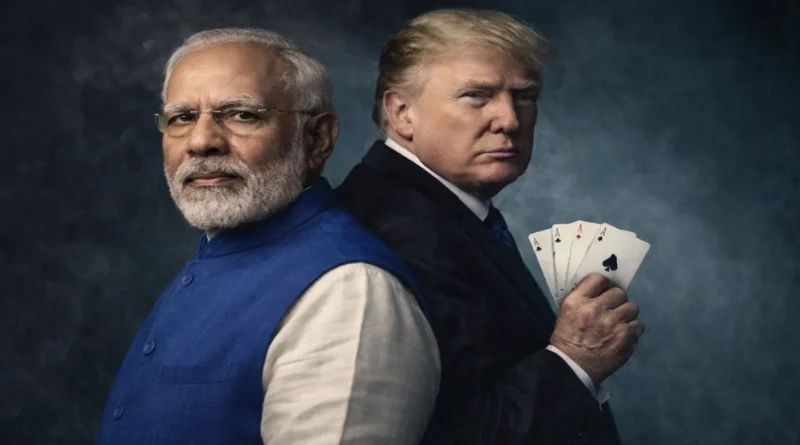
Trump’s Tariff Cut Reshapes India–US Trade Equation, Leaving Pakistan’s Diplomacy on the Sidelines
For months, Pakistan had been lobbying hard in Washington, offering unconditional support in the hope of drawing closer to the United States. Many in Islamabad believed the growing trade friction between India and the US was an opportunity. That calculation now appears badly off the mark.
In a move that undercut Pakistan’s efforts and sent Indian markets soaring, US President Donald Trump announced a sharp reduction in tariffs on Indian goods after speaking with Prime Minister Narendra Modi. The decision reaffirmed the strength of India–US ties and made it clear that New Delhi’s strategic autonomy—not pressure or persuasion—continues to define its foreign policy.
India has repeatedly signalled that it does not want to be dependent on any single country. Prime Minister Modi’s recent engagements—including meetings with Russian President Vladimir Putin and India’s participation in multiple multilateral forums—have reinforced this position. Washington, too, seems to have understood that India will not compromise its core interests under external pressure.
Following this realisation, President Trump announced a reduction in tariffs imposed on India and confirmed progress on a broader India–US trade understanding. The announcement was made through a detailed post on Trump’s social media platform, Truth Social, outlining both the tariff cut and agreement on a trade deal framework.
Deal Announced After Modi–Trump Call
After Trump’s declaration, Prime Minister Modi said he was pleased with the conversation and confirmed that “Made in India” products would now face a reduced tariff of 18 percent. He подчеркed that when the world’s two largest democracies and major economies work together, the outcome creates shared opportunities that benefit people on both sides.
India, however, has not yet released a detailed official statement outlining the fine print of the agreement.
How the Trade Deal Took Shape
- 2 April 2025: The US announced a 25% tariff on Indian goods.
- 27 August 2025: The 25% tariff was reaffirmed and expanded.
- 3 February 2026, 9:16 PM: US Ambassador Sergio Gor informed via social media that Prime Minister Modi and President Trump had spoken on the phone.
- 10:28 PM: President Trump announced tariff cuts and a new trade deal.
- 11:02 PM: Prime Minister Modi publicly confirmed the development.
India–US Trade at a Glance
- Total bilateral trade: approximately ₹12 lakh crore
- Indian exports to the US: around ₹7.91 lakh crore
- Imports from the US: about ₹4.17 lakh crore
India’s Expanding Trade Network
Over the past year, India has signed trade agreements with six partners—Britain, Oman, New Zealand, the European Union, the EFTA bloc, and the United States. The India–EU Free Trade Agreement, often described as the “mother of all deals,” came after decades of negotiations and played a crucial role in reshaping global perceptions of India’s trade leverage.
Impact of Earlier Tariffs
Initially, the US imposed a 25% tariff on India and later added another 25% levy citing India’s purchase of Russian oil. These measures hurt labour-intensive export sectors such as leather, textiles, and gems and jewellery. In December, exports to the US fell 1.83% year-on-year to $6.88 billion. After the 50% tariff came into effect on 27 August, exports from September to December stood at $25.6 billion.
A Question of Economic Self-Respect
India was among the first countries to face higher US tariffs, along with threats of further hikes and restrictions on certain companies. The eventual rollback is widely seen as a validation of India’s economic resilience. As the world’s fastest-growing major economy and currently the fourth-largest globally—on track to become the third—India remains a compelling destination for global investment.
In the Union Budget, Finance Minister Nirmala Sitharaman also addressed sectors affected by US tariffs, providing targeted relief. This sent a strong signal not only to Washington but also to foreign institutional investors who had been pulling funds out of Indian markets.
India’s approach was clear: rather than reacting defensively to tariffs, it diversified trade partnerships. The EU deal, in particular, drew notice in Washington, with senior US officials privately acknowledging surprise at the scale and strategic depth of India’s agreement with Europe—especially at a time when the US was facing its own tensions with NATO allies.
The $500 Billion Purchase Claim
President Trump also claimed that India had agreed to purchase more than $500 billion worth of US energy, technology, agricultural, and other products. In reality, India currently imports less than $50 billion annually from the US. Reaching the $500 billion mark would likely take two decades, suggesting the figure is more a long-term aspiration than an immediate commitment.
Why Caution Is Still Warranted
Despite the upbeat messaging, several aspects of Trump’s announcement remain unclear. His claim that India would reduce tariffs to zero does not specify which products are involved. India has consistently resisted opening sensitive sectors such as agriculture and genetically modified food products.
Trade agreements are complex and legally binding instruments. Until a joint statement, signed documents, and detailed terms are released by both governments, the announcement should be viewed as a strong political signal—not a final, fully concluded deal.
In short, while the tariff cut marks a diplomatic and economic win for India, the real test will lie in the details that emerge in the days ahead.