
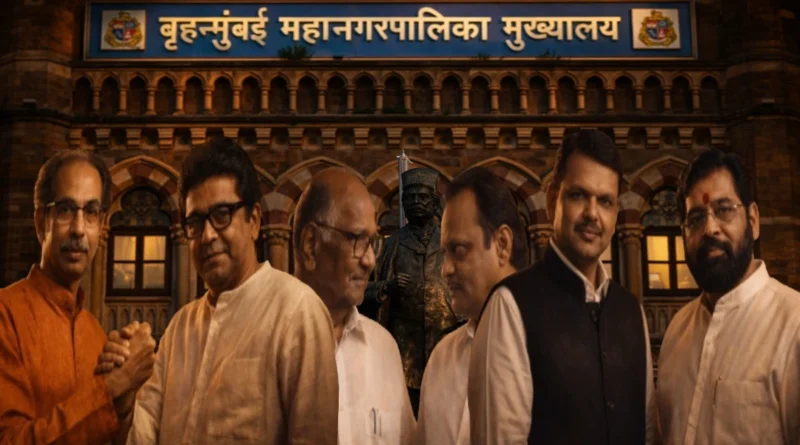
Why the BMC Election Matters More Than Any Other Civic Poll in Maharashtra
Formally, voting will take place on January 15 for elections to Maharashtra’s 29 municipal corporations. But in reality, the spotlight is firmly fixed on just one—the Brihanmumbai Municipal Corporation (BMC). As always, the BMC election has drawn attention on a scale usually reserved for Lok Sabha or Assembly polls.
There are many reasons for this heightened focus. One is the rare political moment of the Thackeray brothers potentially coming together after nearly two decades. Another is that this is the first major election in Maharashtra after the state’s political realignments. Every stakeholder is watching closely—from top political leaders and grassroots workers to India’s biggest business houses and ordinary citizens. Because this contest isn’t just about winning a civic body; it’s about money, power, and control over Maharashtra’s political balance. That’s why every party has turned the BMC election into a matter of prestige.
Bigger Than 28 Municipal Corporations Combined
Although elections are being held for 29 municipal corporations, the BMC stands in a league of its own. Its annual budget exceeds ₹74,000 crore, which is more than the combined budgets of the other 28 municipal corporations in Maharashtra.
The BMC owns assets no other civic body in the country can match—medical colleges, lakes, and large-scale public infrastructure. It also holds nearly ₹50,000 crore in fixed deposits. Experts say this financial muscle ensures uninterrupted funding for development work, allowing elected representatives to deliver on promises without prolonged struggles.
To put things in perspective, a state like Goa could run its entire administration for over two years on the BMC’s annual budget alone. With such enormous resources at stake, it’s hardly surprising that every political party wants a piece of the pie.
Financial Independence Equals Administrative Freedom
The BMC’s wealth gives it near-total financial autonomy. Unlike other municipal bodies, it doesn’t need to depend on state or central assistance for major projects. Massive infrastructure initiatives—like the Coastal Road or sewage treatment plants costing thousands of crores—are executed without financial roadblocks.
A major source of revenue comes from builder premiums under the city’s development plan, along with property tax and compensation linked to GST implementation. This steady income stream makes the BMC one of India’s most powerful civic institutions.
What Winning the BMC Really Means
Victory in the BMC isn’t just about controlling a ₹74,000 crore budget or accessing surplus funds. It brings institutional authority over Mumbai itself. Under the Municipal Corporation Act of 1888, every development-related activity in India’s financial capital requires BMC approval.
Whether it’s sanctioning building plans, approving new construction, or even laying roads and drains—nothing moves without the BMC’s consent. In effect, winning the BMC means governing Mumbai.
Money, Authority, and Political Influence
Six Lok Sabha constituencies fall entirely within the BMC’s limits. In the Assembly, the BJP-led Mahayuti currently holds an edge with 22 of 36 seats, while the Maha Vikas Aghadi leads in the Lok Sabha with four seats.
This makes the BMC a rare political prize that combines financial power, administrative control, and electoral influence. That’s why every party—both factions of Shiv Sena and NCP, the MNS, BJP, and Congress—is desperate to secure as many seats as possible.
Faces That Dominated the Headlines
Dinesh Waghmare (State Election Commissioner)
From announcing the polls to handling allegations of code-of-conduct violations, Waghmare remained under constant scrutiny. Conducting simultaneous elections amid party splits and an expanded political field posed a massive logistical challenge for the Election Commission.
Rahul Narvekar (Assembly Speaker)
The BJP faced criticism after three members of Narvekar’s family received tickets. Allegations of administrative interference during nominations and questions over a dramatic rise in his brother Makrand’s assets forced the Election Commission to seek formal explanations.
Sanjay Raut (MP, Uddhav Sena)
Health concerns kept Raut away from public events at a crucial time, creating a leadership vacuum for the party. With speculation around a Raj–Uddhav alliance and mounting media pressure, the absence was keenly felt—until Raut returned to active campaigning as elections neared.
Harshvardhan Sapkal (Maharashtra Congress President)
Despite Congress announcing it would contest alone, Sapkal played a key role in forging an alliance with the Vanchit Bahujan Aghadi. However, confusion over seat-sharing and delayed candidate announcements led to embarrassment for the party.
Nawab Malik (NCP)
Malik became the key reason Ajit Pawar’s faction stayed out of the Mahayuti. BJP refused to ally while Malik held the reins, forcing NCP (Ajit Pawar) to contest 94 seats independently, including 22 Muslim candidates, disrupting opposition vote calculations.
Party-Wise Challenges
BJP
For the first time, BJP has openly declared its ambition to capture the Mayor’s post in Mumbai. Having narrowly missed out last time, the party has left nothing to chance. Riding on its alliance with Eknath Shinde’s Shiv Sena, BJP is attempting to replicate its Assembly success. The allocation of 90 seats to Shiv Sena (Shinde) is seen as the key variable that could decide the mayoral math.
Shiv Sena (Uddhav Thackeray)
This election is existential for Uddhav Thackeray. After losing power and party control in 2022, retaining influence over the BMC is critical. For the first time since the MNS was formed, Uddhav and Raj Thackeray have joined forces. Uddhav is personally reconnecting with party branches, while Aaditya Thackeray is courting young voters. Despite support from Marathi and Muslim voters, converting vote share into the mayor’s chair remains a tough challenge.
Congress
Once dominant in Mumbai, Congress has struggled to regain relevance since its 2014 wipeout. Despite announcing a solo run, it eventually ceded 62 seats to VBA. Delayed candidate lists and intense competition for Muslim votes—from UBT, SP, NCP (AP), and AIMIM—make its target of 50+ seats uncertain.
Nationalist Congress Party
NCP’s presence in Mumbai has always been limited, and the party split has only weakened it further. Sharad Pawar’s faction is contesting 11 seats with the Thackerays, while Ajit Pawar’s faction is going big with 94 candidates, many of them Muslim. The Malik family plays a central role in strategy, as the party eyes a stronger foothold in civic power.
Samajwadi Party
Traditionally popular among North Indian and Muslim voters, the SP is battling internal divisions. Tensions between MLA Rais Shaikh and state president Abu Asim Azmi are now public, threatening the party’s prospects. To maintain relevance, the SP must win at least 7–8 seats to secure representation on the Standing Committee.