
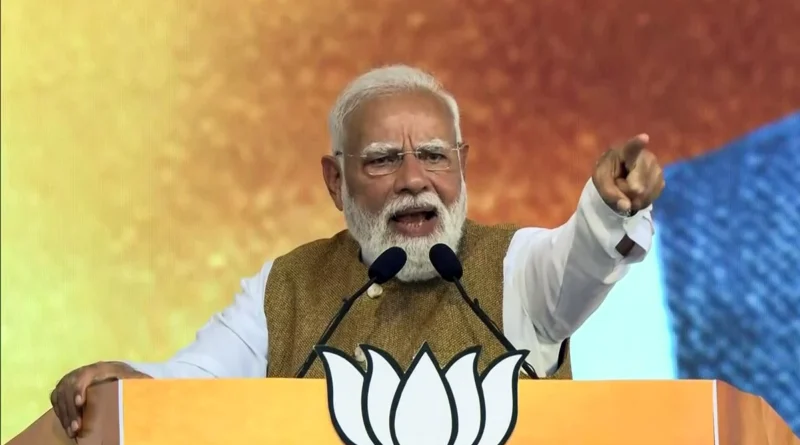
Modi’s Southern Push: A Strategic Bid to Expand BJP’s Footprint in Kerala and Tamil Nadu
With the ambition of making political inroads in traditionally difficult southern terrain, Prime Minister Narendra Modi launched an intensive campaign tour across Kerala and Tamil Nadu, formally kicking off the BJP-led National Democratic Alliance’s election drive ahead of upcoming assembly polls. The visit carried strong political messaging, blending inaugurations of development projects with sharp attacks on opposition parties.
In Kerala, the Prime Minister began his tour with a high-energy roadshow in Thiruvananthapuram. Recent gains by the BJP in local body elections, including securing the mayor’s post in the state capital, have boosted the morale of party workers. Riding on this momentum, Modi flagged off railway projects and laid foundation stones for several infrastructure initiatives. Addressing public gatherings, he emphasized that Kerala could move towards a new future through development-oriented governance and transparency.
Modi also directly targeted the ruling Left Front, raising questions over the disappearance of gold linked to the Sabarimala temple, while simultaneously criticizing the Congress for its alliance with the Muslim League. He accused the party of encouraging extremist tendencies in the state. A lighter, human moment during the rally — when a child stood holding a sketch of the Prime Minister — drew public attention and added a personal touch to the visit, reflecting a softer side of the campaign.
In contrast, Modi adopted a far more confrontational tone in Tamil Nadu. Speaking at NDA rallies, he accused the ruling Dravida Munnetra Kazhagam (DMK) of dynastic politics, corruption, disrespect towards women, and undermining Tamil culture. According to him, such governance was damaging the state’s values and long-term growth. He positioned the NDA as a credible alternative built on integrity, women’s dignity, and cultural pride.
Highlighting Tamil Nadu’s deep historical and cultural legacy, Modi spoke extensively about Sangam literature, ancient scientific traditions, iconic temples, and the state’s modern technological contributions, describing them as pillars of Indian civilization. Addressing gatherings near Chennai in Chengalpattu and Madurantakam, he asserted that Tamil Nadu would play a decisive role in achieving the vision of a developed India. He also contrasted the Centre’s efforts over the past eleven years with previous UPA governments, alleging that earlier administrations failed to allocate sufficient resources to the state.
The Prime Minister praised former Chief Minister J. Jayalalithaa for strengthening law and order and expressed concern over women’s safety in the present scenario. By invoking the Pongal festival and remembering leaders like M.G. Ramachandran, Modi attempted to connect with regional sentiments and popular memory. His consistent message across platforms was clear: Tamil Nadu is ready for political change.
Strengthening political equations in Kerala, Modi also met industrialist Sabu M. Jacob and welcomed his Twenty20 organization into the NDA fold. His interactions with saints associated with Sivagiri Mutt in Varkala and the spiritual legacy of Sree Narayana Guru underlined themes of social harmony and equality.
Historically, southern India has remained a challenging region for the BJP, shaped by strong ideological traditions, regional identity, and coalition-driven politics. In this context, Modi’s back-to-back visits were not just routine campaign stops but a calculated strategic move. The BJP’s recent local success in Kerala has given it confidence that organizational expansion and a development-focused agenda could gradually strengthen its base. The roadshows and outreach to influential social groups signal an effort to go beyond electoral rhetoric and build deeper societal connections.
Tamil Nadu presents an even more complex picture. Here, the BJP aims to contest not in isolation but as the core of a broad opposition alliance under the NDA banner. Attacks on the DMK over dynastic rule and corruption, combined with accusations of disregarding Tamil pride, reflect a deliberate attempt to align with regional identity. By invoking iconic figures like Jayalalithaa and MGR, Modi sought to fill an emotional and political space that has long shaped the state’s electoral landscape.
Despite these efforts, challenges remain formidable. The DMK’s strong organizational grip in Tamil Nadu and Kerala’s entrenched leftist politics continue to pose significant obstacles. Yet, Modi’s intensive southern campaign makes one thing clear: the BJP no longer wishes to remain on the margins in the South. If its strategy rooted in development, culture, and governance is matched with sustained grassroots organization, the possibility of the lotus blooming even on rocky ground cannot be ruled out.