
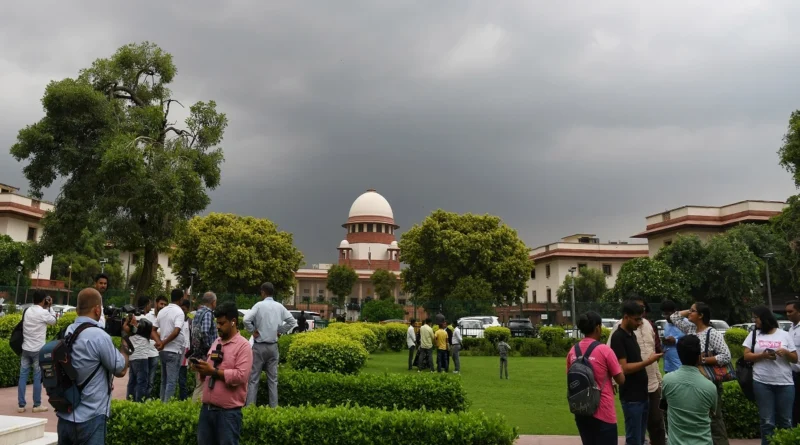
Supreme Court Takes Firm Stand on West Bengal SIR: No Obstruction Allowed, Deadline Extended to February 21
During a crucial hearing on the Special Investigation Report (SIR) process in West Bengal, Chief Justice of India (CJI) Suryakant made it clear that the Supreme Court will not tolerate any obstruction in the ongoing SIR exercise. Striking a firm tone, the CJI stated that while the Court is open to issuing corrective directions wherever improvements are needed, any attempt to hinder the process will not be allowed under any circumstances.
Emphasizing the broader implications, the Chief Justice remarked that all states must take note of this position, underscoring the Court’s resolve to ensure the integrity of the process.
Supreme Court Extends Key Deadline by One Week
In a significant procedural decision, the Supreme Court on Monday extended the deadline for document verification and publication of the final electoral roll in West Bengal. The earlier cut-off date of February 14 has now been pushed to February 21, granting authorities an additional week to complete the exercise.
The CJI observed that had the list of appointed officials been submitted by February 5, the Election Commission of India (ECI) would likely have already taken a decision on the matter. This delay, he noted, contributed to the current situation.
A Bench comprising Justice Joymalya Bagchi and Justice N.V. Anjaria stressed that the revision process must continue strictly according to the prescribed timeline, reinforcing the urgency and importance of adhering to procedural discipline.
Election Commission Flags Concerns Over Officer Appointments
Appearing on behalf of the Election Commission, Senior Advocate D.S. Naidu raised serious concerns regarding the appointment of Electoral Registration Officers (EROs). He argued that EROs perform quasi-judicial functions, and therefore must possess adequate judicial experience to fairly discharge their responsibilities.
Naidu informed the Court that the ECI had sought the appointment of around 300 Group B officers with relevant experience. However, only 64 such officers were made available. The remaining appointments, he said, were carried out based on pay parity rather than suitability or experience.
He further contended that officials from technical backgrounds, such as engineers, are not equipped to handle judicial decision-making under the SIR framework—especially when such decisions are subject to challenge before appellate authorities.
Questions Raised on the Role of Micro Observers
The effectiveness of micro observers also came under scrutiny. Senior Advocate Shyam Divan argued that the large-scale deletion of voters’ names could not realistically be managed through micro observers alone, given the vast scope and complexity of the SIR process.
Highlighting the urgency of the matter, Divan informed the Court that the SIR exercise was originally scheduled to conclude on February 14. Acknowledging these concerns, the Court, during the same hearing, extended the deadline for finalizing SIR data by one additional week.
Court Signals Zero Tolerance for Delays or Disruptions
Taken together, the Court’s observations and orders send a strong message: while procedural corrections are welcome, delays, administrative lapses, or intentional roadblocks will not be tolerated. With the revised deadline now set for February 21, all stakeholders are under clear judicial direction to ensure the SIR process moves forward smoothly, transparently, and within the extended timeframe.