
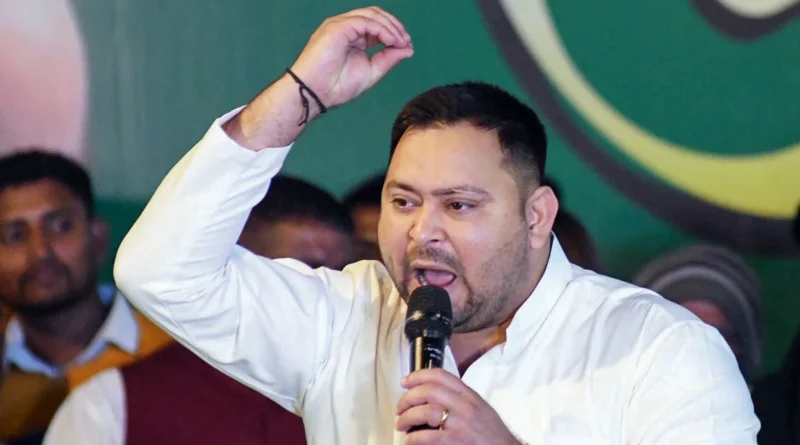
War of Words Erupts in Bihar: Tejashwi Yadav Hits Back After Mythological Swipe in Assembly
Bihar’s political arena is once again echoing with sharp exchanges, as a fresh controversy has sparked what many are calling a rhetorical “Mahabharata” between rival camps.
At the center of the storm is Tejashwi Yadav, leader of the opposition and executive president of the Rashtriya Janata Dal (RJD), who has strongly objected to remarks made by singer-turned-politician Maithili Thakur during a recent Assembly session.
Although Yadav stopped short of naming her directly in his official response, a social media post featuring her photograph left little doubt about who he was addressing.
The Assembly Remark That Sparked It All
The controversy began on Thursday when Maithili Thakur, speaking in the state Assembly, drew an indirect comparison that quickly grabbed attention.
Referring obliquely to the political landscape before 2005, she appeared to liken the affection shown by RJD chief Lalu Prasad Yadav toward his younger son Tejashwi to the mythological bond between King Dhritarashtra and his son Duryodhana in the epic Mahabharata.
While she avoided mentioning names, the allusion was unmistakable. By invoking “Bihar before 2005,” a phrase often used by critics to target RJD’s past governance record, she signaled that her remarks were aimed squarely at the party’s legacy.
Tejashwi’s Counterattack
Tejashwi Yadav responded with a pointed message online, accusing certain newly elected legislators of overestimating their political wisdom the moment they enter public office.
Without explicitly identifying Thakur, he suggested that some individuals, lacking a fundamental understanding of legislative functioning, dare to make disparaging comments about a “jananayak” — a term he used to describe his father, Lalu Prasad Yadav.
The choice of words was deliberate. By invoking the label “jananayak” (people’s leader), Tejashwi framed the remarks not merely as personal criticism, but as an insult to a mass leader with deep-rooted public support.
Why the Controversy Matters
Beyond the exchange itself, the episode carries broader political undertones:
1. Defending a Legacy
By forcefully pushing back, Tejashwi signaled that criticism of Lalu Prasad Yadav would be treated as an attack on the RJD’s ideological core. Protecting the party’s legacy remains central to its political strategy.
2. Experience vs. New Entrants
Tejashwi’s remarks also appeared to question Thakur’s political experience, portraying her as inexperienced in legislative matters. The subtext was clear: popularity outside politics does not automatically translate into political maturity.
3. The “Pre-2005” Narrative
The reference to Bihar before 2005 remains a sensitive political fault line. Opponents of the RJD frequently highlight that period to criticize governance under Lalu Prasad Yadav, while the party counters by emphasizing social justice and empowerment narratives. The phrase continues to be a powerful electoral talking point.
A New Voice, A New Debate
Maithili Thakur, widely recognized for her singing career before entering politics, has quickly become a visible figure in Bihar’s legislative debates. Her comments have opened a fresh round of political sparring, with the RJD camp calling it an affront to its leadership, while rivals describe her remarks as speaking an uncomfortable truth.
For now, the exchange remains verbal — but in Bihar’s charged political climate, words often carry the weight of weapons. Whether this duel escalates or settles into routine partisan friction will become clearer in the days ahead.
One thing is certain: in Bihar politics, mythology and modern strategy often collide — and neither side appears willing to retreat.