
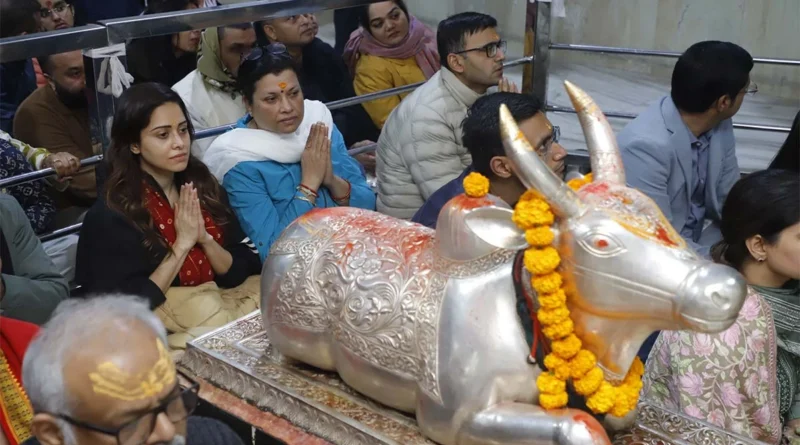
When Faith Meets Freedom: Nusrat Bharucha’s Temple Visit Sparks a Wider Debate
A spiritual visit by Bollywood actress Nusrat Bharucha to the world-famous Mahakaleshwar Jyotirlinga in Ujjain has unexpectedly turned into a political and religious controversy. What began as a personal act of devotion soon became a flashpoint for debates on faith, identity, and individual freedom.
On Tuesday, Nusrat visited the Mahakal temple, where she took part in the Bhasma Aarti, offered prayers, and sought blessings inside the sanctum by presenting a ceremonial cloth. This was her second visit to the shrine, which she described as a deeply beautiful and fulfilling experience. Photos and videos she shared online showed her fully immersed in devotion—applying a tilak, performing jal abhishek, and participating in the rituals. In a video message, she praised the temple management for their arrangements for devotees and said she hopes to visit Mahakal every year. Ahead of the New Year, she also posted an Instagram story from the temple, writing “Jai Mahakal.”
However, the moment of faith soon drew criticism. The national president of the All India Muslim Jamaat, Maulana Mufti Shahabuddin Razvi Barelvi, objected to Nusrat’s temple visit and participation in Hindu rituals and issued a fatwa against her. According to the fatwa, a Muslim woman engaging in idol worship and rituals of another religion goes against Sharia and is considered a serious sin. The cleric stated that acts such as applying tilak, offering water, and joining the Bhasma Aarti cross the boundaries of Islamic principles.
At the same time, he clarified that he holds no legal authority and can only offer religious guidance. He advised Nusrat to repent, seek forgiveness, and recite Islamic prayers as atonement. The fatwa quickly ignited intense discussions on social media. Many people criticized it as interference in personal belief, while others called it an example of religious rigidity. Responding to the backlash, Razvi said he was unaffected by hateful messages and claimed that he has always spoken out against violence toward Hindus in places like Bangladesh, Kashmir, and Pakistan. He added that if Nusrat considers herself a “good Muslim,” she would accept his advice; otherwise, she is free to ignore it.
Beyond the headlines, this controversy is not merely about an actress visiting a temple. It reflects a mindset that still seeks to police personal faith. The real question is not which religion someone belongs to, but whether anyone has the right to label another person’s spiritual experience as a “sin.” The Indian Constitution guarantees every citizen the freedom to believe, not believe, and practice spirituality in their own way. Nusrat Bharucha neither insulted any religion nor harmed anyone’s beliefs—she simply expressed devotion at a place of worship.
The most troubling aspect of a fatwa is not its lack of legal power, but the psychological pressure it creates. It sends a message that stepping outside an approved interpretation makes one unacceptable or “wrong.” Such thinking divides society instead of bringing people together. Ironically, calls for harmony and coexistence often come from the same spaces where declarations are made that deepen social divides. The role of religious leadership should be to guide toward compassion, not to instill fear.
Nusrat Bharucha saying “Jai Mahakal” is not an attack on anyone’s faith. It represents an India where people worship out of devotion, not fear. The choice before society is clear: embrace that inclusive India, or surrender to a narrow mindset that demands certificates of loyalty at every step.