
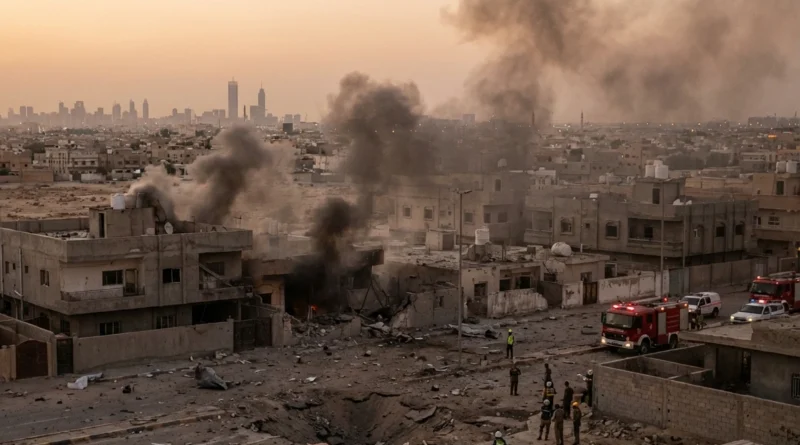
Afghanistan-Pakistan War – Durand Line Conflict
The Afghan Ministry of Defense reported that several key military locations along the Durand Line have been attacked as the fighting has entered its fifth day. The targeted areas include Kabul, the Ali Sher district in Khost, Jalalabad, and Kandahar.
Amid the ongoing large-scale conflict in the Middle East, tensions have now sharply escalated in South Asia as well. On the fifth day of clashes along the Durand Line—the border between Afghanistan and Pakistan—Afghanistan’s Taliban-led forces launched heavy retaliatory strikes against Pakistani military positions. Relations between the two countries reached a peak of tension after Afghanistan’s Ministry of Defense claimed it had captured several Pakistani military posts.
The escalation follows recent Pakistani Air Force airstrikes inside Afghanistan, which Afghan forces say prompted their counterattacks on Pakistani military bases. According to Afghanistan’s Defense Ministry, key military locations along the Durand Line came under attack as fighting entered its fifth day, including areas around Kabul, the Ali Sher district in Khost, Jalalabad, and Kandahar.
The latest flare-up marks a significant escalation along the 2,600-kilometer Durand Line, where tensions have been rising since February 21–22, after Pakistan reportedly carried out strikes on alleged militant camps.
Afghan officials claim their forces captured multiple Pakistani military posts in Kandahar province’s Spin Boldak and Shorabak districts. In Spin Boldak, three posts were reportedly seized, with three Pakistani soldiers killed and one taken prisoner. Local media outlet TOLOnews reported that two additional Pakistani posts were captured in the Ali Sher district.
For the past four days, Pakistani and Afghan forces have been targeting each other’s border positions. Although described as the most intense clashes in years, the level of fighting has reportedly decreased compared to the initial days.
The conflict began last month when Taliban-led Afghan forces responded to Pakistani operations targeting militants inside Afghanistan by launching retaliatory strikes on Pakistani military sites.
On Monday, Afghanistan’s Defense Ministry announced the destruction of a Pakistani armored tank in Paktika province, alleging it had been firing indiscriminately into Afghan territory. According to Reuters, Defense Ministry spokesperson Inayatullah Khwarazmi claimed that Afghan forces had killed more than 100 Pakistani personnel and captured over 25 military posts.
Afghan police also reported that Pakistani jets attempted to bomb Bagram Air Base near Kabul but were intercepted by Afghan air defense systems. No casualties or damage were reported. Bagram previously served as the largest U.S. military base in Afghanistan during the two-decade-long war. Pakistani security sources confirmed ongoing air and ground strikes targeting ammunition depots in Khost and Jalalabad, as well as a drone storage facility in Jalalabad.
Meanwhile, Pakistan’s Information Minister Ataullah Tarar claimed that Pakistani forces had killed 435 Afghan soldiers, destroyed 188 posts, and seized 31 positions. He also stated that 51 locations were targeted from the air, resulting in the destruction of 188 tanks, armored vehicles, and artillery guns.
Despite mediation offers from countries such as Qatar, no progress toward peace has been reported. The Afghan Taliban have expressed willingness to hold talks, but broader regional tensions—including U.S. and Israeli strikes against Iran and Tehran’s retaliatory attacks on American and Israeli bases in the Middle East—have complicated diplomatic efforts.
At the core of the dispute is Pakistan’s accusation that Afghanistan is sheltering militants from Tehrik-e-Taliban Pakistan (TTP), who carry out attacks inside Pakistan. Afghanistan denies the allegation, stating that it does not allow its territory to be used against other countries.
Pakistan’s Foreign Minister Ishaq Dar reiterated that Islamabad’s sole demand is that Afghan soil not be used for attacks against Pakistan, emphasizing that resolving this issue is essential for normalizing relations between the two neighbors.