
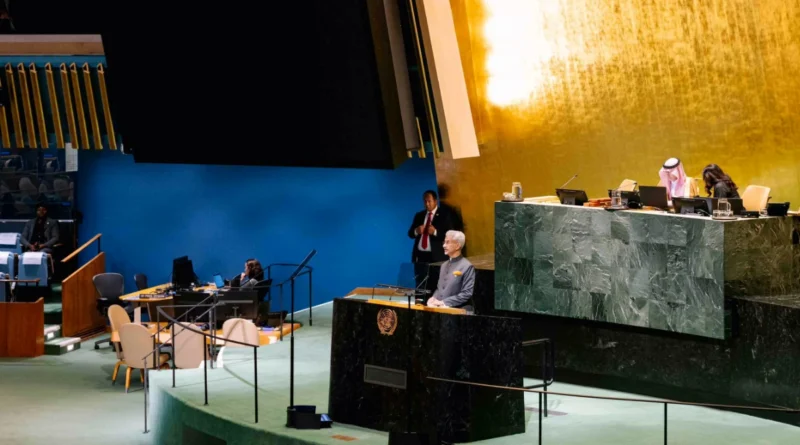
Four Years of War: India Stays Neutral as UN General Assembly Pushes for Ukraine Ceasefire
As the Russia–Ukraine conflict entered its fourth year, the United Nations General Assembly became the stage for a renewed global appeal for peace. A draft resolution was tabled calling for an immediate and unconditional ceasefire, alongside efforts to secure a lasting and just peace in Ukraine.
Yet when the moment came to cast votes, India once again chose not to take sides.
A Divided International Community
The resolution, introduced by Ukraine, underscored the need for a comprehensive peace framework rooted in the principles of the UN Charter and international law. It demanded an end to hostilities without preconditions and reaffirmed support for Ukraine’s sovereignty and territorial integrity within its internationally recognized borders, including its territorial waters.
When the votes were counted, the divisions were evident:
- 107 countries voted in favor
- 12 countries voted against
- 51 countries, including India, abstained
The outcome reflected a world still grappling with competing geopolitical interests, strategic alignments, and differing interpretations of how peace should be pursued.
What the Resolution Sought
Beyond the call for a ceasefire, the draft resolution addressed several humanitarian concerns. It reiterated demands for:
- A full exchange of prisoners of war
- The release of all individuals detained unlawfully
- The return of civilians and detainees forcibly transferred or deported, including children
The text emphasized that any durable solution must respect Ukraine’s sovereignty, independence, unity, and territorial integrity. It framed peace not merely as the absence of fighting, but as a settlement grounded in international norms.
India’s Calculated Distance
India’s abstention is consistent with its position since the conflict began. From the outset, New Delhi has maintained that military confrontation cannot deliver a sustainable resolution. Instead, it has repeatedly advocated diplomacy, dialogue, and engagement as the only viable path forward.
By stepping back from the vote, India signaled its intention to avoid alignment with either bloc. Rather than endorsing or rejecting the resolution, it appears to be preserving strategic space—positioning itself as a country willing to engage all sides while refraining from overt partisanship.
Balancing Principles and Pragmatism
India’s approach reflects a broader foreign policy doctrine that blends principle with pragmatism. While it has consistently called for respect for sovereignty and territorial integrity, it has also emphasized the complexity of the geopolitical landscape and the need for sustained diplomatic channels.
In a polarized global environment, abstention is not necessarily silence—it can also be a statement of strategic restraint.
As the war drags into its fourth year, the UN’s renewed push for a ceasefire underscores the urgency felt by much of the international community. But with major powers and influential states divided on the best path forward, the search for consensus—and for peace—remains a formidable challenge.