
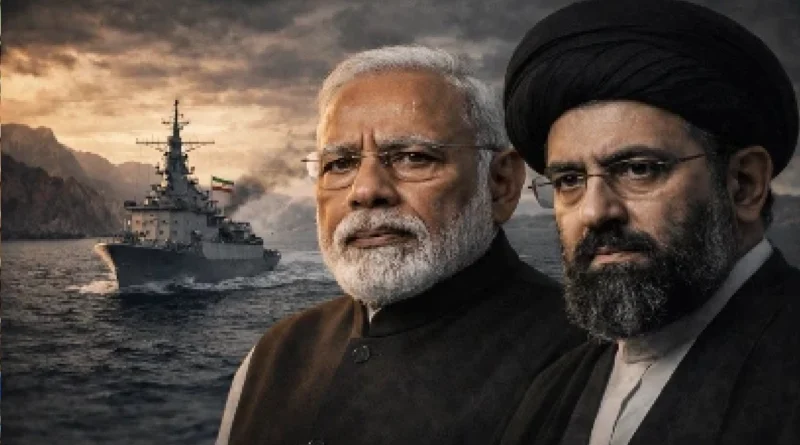
India Takes Strong Stand Against Iran at the UN
No country voted against the draft; it was a unanimous decision. In the Security Council, 13 members voted in favor while two abstained. The resolution calls on Iran to immediately halt all attacks and condemns its threats to close the Strait of Hormuz. India sponsored the resolution at the United Nations Security Council (UNSC).
The United Nations Security Council (UNSC) has passed a draft resolution condemning Iran’s attacks on Gulf countries and Jordan, demanding that Tehran immediately halt all hostilities. Sponsored by the Gulf Cooperation Council (GCC) and co-sponsored by 135 other UN member states, the resolution was adopted with 13 out of 15 Council members voting in favor, while no country voted against it and two abstained. India sponsored the resolution at the UNSC.
Support and Voting:
The 15-member Security Council, chaired by the United States, adopted the resolution on Wednesday with 13 votes in favor. China and Russia, both permanent members with veto powers, abstained from voting. India co-sponsored the resolution along with over 130 other countries, including Australia, Austria, Bangladesh, Bhutan, Canada, Egypt, France, Germany, Greece, Italy, Japan, Kuwait, Malaysia, Maldives, Myanmar, New Zealand, Norway, Oman, Pakistan, Qatar, Saudi Arabia, Singapore, Spain, Ukraine, UAE, the UK, the US, Yemen, and Zambia. The resolution strongly reaffirmed support for the sovereignty, territorial integrity, and political independence of Bahrain, Kuwait, Oman, Qatar, Saudi Arabia, UAE, and Jordan, and condemned in the strongest terms Iran’s attacks on these nations, describing such acts as violations of international law and serious threats to global peace and security.
Demands in the Resolution:
The resolution demands that Iran immediately cease all attacks on GCC countries and Jordan, including any provocative or threatening actions using proxy groups. It emphasizes the importance of respecting the rights of international navigation, particularly in key maritime routes, in accordance with international law. The resolution also condemns any attempt or threat by Iran to close, obstruct, or interfere with international shipping through the Strait of Hormuz or endanger maritime security in Bab al-Mandab. It highlights attacks on residential areas and civilian infrastructure, noting casualties among civilians and damage to non-military buildings, and expresses solidarity with the countries and populations affected.
Statements from the United States:
US Ambassador to the UN, Mike Waltz, called the resolution a “direct and clear statement by the Gulf countries condemning the brutality of the Iranian regime,” condemning Iran’s targeting of civilians and civilian infrastructure. Waltz said that President Donald Trump and his team had pursued every diplomatic effort to maintain peace and resolve 47 years of hostility, but Iran had escalated missile, drone, and nuclear threats. He thanked the 135 co-sponsoring countries for their support.
Iran’s Response:
Iran’s Permanent Representative to the UN, Ambassador Amir Saeed Iravani, rejected the UNSC action as unfair and illegal, claiming it violates the UN Charter and international law. Iravani accused the US and Israel of causing more than 1,348 civilian deaths, over 17,000 injuries, and damage to 19,734 civilian sites since the conflict began on February 28. He labeled these acts as war crimes and crimes against humanity. Iravani emphasized that Iran is committed to maintaining friendly relations with Gulf countries based on mutual respect, sovereignty, and territorial integrity, and said Iran’s defensive actions targeting US military bases do not threaten the sovereignty or territorial integrity of regional states.
This resolution marks a firm stance by the UNSC, led by India and the GCC, against Iran’s aggression and highlights international concerns over the destabilization of the Gulf region.